
Logo Oapen
  • Join
    • Deposit
    • For Librarians
    • For Publishers
    • For Researchers
    • Funders
    • Resources
    • OAPEN
        View Item 
        •   OAPEN Home
        • View Item
        •   OAPEN Home
        • View Item
        JavaScript is disabled for your browser. Some features of this site may not work without it.

        Archaeology on the Apulian – Lucanian Border
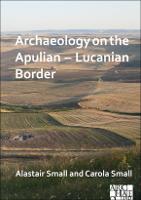
        Thumbnail
        Download PDF Viewer
        Author(s)
        Small, Alastair
        Collection
        Knowledge Unlatched (KU); KU Open Services
        Number
        50731b42-fd1e-4633-baa1-e5a980658fb6
        Language
        English
        Show full item record
        Abstract
        The broad valley of the Bradano river and its tributary the Basentello separates the Apennine mountains in Lucania from the limestone plateau of the Murge in Apulia in South East Italy. For millennia the valley has functioned both as a cultural and political divide between the two regions, and as a channel for new ideas transmitted from South to North or vice versa depending on the political and economic conditions of the time. Archaeology on the Apulian – Lucanian Border aims to explain how the pattern of settlement and land use changed in the valley over the whole period from Neolithic to Late Medieval, taking account of changing environmental conditions, and setting the changes in a broader political, social and cultural context. There are three levels of focus. The first is on the results of a field survey (1996-2006) in the Basentello valley by teams from the Universities of Alberta, Edinburgh, and Bari, directed by the authors. The second concerns the discoveries of earlier field surveys in the late 1960s and early 1970s undertaken in connection with excavations on Botromagno near Gravina in Puglia. The third is a much broader synthesis of the results of recent scholarship using archaeological, epigraphic and literary sources to reconstruct an archaeological history of the valley and the surrounding area. The creation of a vast imperial estate at Vagnari around the end of the 1st century BC and its long-lasting impact on the pattern of settlement in the area is a significant theme in the later chapters of the book.
        URI
        https://library.oapen.org/handle/20.500.12657/100031
        Keywords
        Social Science; Archaeology
        ISBN
        9781803270654, 9781803270654
        Publisher
        Archaeopress Publishing
        Publisher website
        https://www.archaeopress.com/
        Publication date and place
        2022
        Grantor
        • Knowledge Unlatched
        Imprint
        Archaeopress Publishing Ltd
        Classification
        Archaeology
        Rights
        https://creativecommons.org/licenses/by-nc-nd/4.0/legalcode
        • Harvested from KU

        Browse

        All of OAPENSubjectsPublishersLanguagesCollections

        My Account

        LoginRegister

        Export

        Repository metadata
        Logo Oapen
        • For Librarians
        • For Publishers
        • For Researchers
        • Funders
        • Resources
        • OAPEN

        Newsletter

        • Subscribe to our newsletter
        • view our news archive

        Follow us on

        License

        • If not noted otherwise all contents are available under Attribution 4.0 International (CC BY 4.0)

        Credits

        • logo EU
        • This project received funding from the European Union's Horizon 2020 research and innovation programme under grant agreement No 683680, 810640, 871069 and 964352.

        OAPEN is based in the Netherlands, with its registered office in the National Library in The Hague.

        Director: Niels Stern

        Address:
        OAPEN Foundation
        Prins Willem-Alexanderhof 5
        2595 BE The Hague
        Postal address:
        OAPEN Foundation
        P.O. Box 90407
        2509 LK The Hague

        Websites:
        OAPEN Home: www.oapen.org
        OAPEN Library: library.oapen.org
        DOAB: www.doabooks.org


        Export search results

        The export option will allow you to export the current search results of the entered query to a file. Differen formats are available for download. To export the items, click on the button corresponding with the preferred download format.

        A logged-in user can export up to 15000 items. If you're not logged in, you can export no more than 500 items.

        To select a subset of the search results, click "Selective Export" button and make a selection of the items you want to export. The amount of items that can be exported at once is similarly restricted as the full export.

        After making a selection, click one of the export format buttons. The amount of items that will be exported is indicated in the bubble next to export format.