
Logo Oapen
  • Join
    • Deposit
    • For Librarians
    • For Publishers
    • For Researchers
    • Funders
    • Resources
    • OAPEN
        View Item 
        •   OAPEN Home
        • View Item
        •   OAPEN Home
        • View Item
        JavaScript is disabled for your browser. Some features of this site may not work without it.

        The Inclusive Economy

        Criteria, Principles and Ubuntu
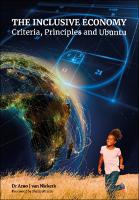
        Thumbnail
        Download PDF Viewer
        Web Shop
        Author(s)
        van Niekerk, Arno
        Language
        English
        Show full item record
        Abstract
        There is one serious missing link at the center of today’s capitalism. It is a disequilibrium between increased economic interconnectedness and increased isolation/exclusion. This unique challenge in the 21st century calls for a unique solution: Ubuntu. Africa might be the last place where experts would look for an economic solution, but it ironically holds the secret to restoring the right equilibrium in the economy. Ubuntu’s ability to reconnect the marginalised with the mainstream by putting emphasis on our humanness, connectedness, collective growth through expansion and improved efficiency creates new capacity for the economy to rebalance itself towards genuine and sustainable progress. Ubuntu encapsulates that which is the opposite of economic exclusion (i.e. inequality, poverty, unsustainable growth, limited profits, etc.), namely economic inclusion. However, only a small window of opportunity exists – in and after the COVID-19 pandemic – to implement Ubuntu as a fundamental economic principle in order for it to be an effective remedy. The global economy and most local economies have entered the phase of rebuilding with a serious drawback: after the previous global financial crisis, both the economy and government’s capacity to recover are severely limited as unemployment levels, debt levels and natural resource depletion levels keep soaring, resulting in dangerous levels of economic exclusion and social instability. To this and more, the inclusive economy presents tangible solutions.
        URI
        https://library.oapen.org/handle/20.500.12657/100507
        Keywords
        Circular economy;Collaborative economy;Economic Inclusivity;Economic progress;Economics;Economic theory;Great transition;Inclusive economy;Inclusive growth;Inequality;Institutions;Policies;Ubuntu
        DOI
        10.36615/9781776402366
        ISBN
        9781776402366, 9781776402359, 9781776413461, 9781776402373
        Publisher
        UJ Press
        Publisher website
        https://ujonlinepress.uj.ac.za/index.php/ujp
        Publication date and place
        Johannesburg, 2022
        Classification
        Development economics and emerging economies
        Pages
        506
        Rights
        https://creativecommons.org/licenses/by-nc/4.0/
        • Imported or submitted locally

        Browse

        All of OAPENSubjectsPublishersLanguagesCollections

        My Account

        LoginRegister

        Export

        Repository metadata
        Logo Oapen
        • For Librarians
        • For Publishers
        • For Researchers
        • Funders
        • Resources
        • OAPEN

        Newsletter

        • Subscribe to our newsletter
        • view our news archive

        Follow us on

        License

        • If not noted otherwise all contents are available under Attribution 4.0 International (CC BY 4.0)

        Credits

        • logo EU
        • This project received funding from the European Union's Horizon 2020 research and innovation programme under grant agreement No 683680, 810640, 871069 and 964352.

        OAPEN is based in the Netherlands, with its registered office in the National Library in The Hague.

        Director: Niels Stern

        Address:
        OAPEN Foundation
        Prins Willem-Alexanderhof 5
        2595 BE The Hague
        Postal address:
        OAPEN Foundation
        P.O. Box 90407
        2509 LK The Hague

        Websites:
        OAPEN Home: www.oapen.org
        OAPEN Library: library.oapen.org
        DOAB: www.doabooks.org


        Export search results

        The export option will allow you to export the current search results of the entered query to a file. Differen formats are available for download. To export the items, click on the button corresponding with the preferred download format.

        A logged-in user can export up to 15000 items. If you're not logged in, you can export no more than 500 items.

        To select a subset of the search results, click "Selective Export" button and make a selection of the items you want to export. The amount of items that can be exported at once is similarly restricted as the full export.

        After making a selection, click one of the export format buttons. The amount of items that will be exported is indicated in the bubble next to export format.