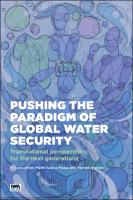
Pushing the Paradigm of Global Water Security
| dc.contributor.editor | Anker, Victoria | |
| dc.contributor.editor | Maysels, Rachael | |
| dc.contributor.editor | Valasia Peppa, Maria | |
| dc.date.accessioned | 2025-07-15T14:59:12Z | |
| dc.date.available | 2025-07-15T14:59:12Z | |
| dc.date.issued | 2024 | |
| dc.identifier | ONIX_20250715T165342_9781789062540_9 | |
| dc.identifier.uri | https://library.oapen.org/handle/20.500.12657/104236 | |
| dc.description.abstract | This book brings together early career researchers, non-governmental organisations and industry practitioners, indigenous and local communities, and government agency workers to interrogate the concept of water security. By collating multicultural perspectives, diverse contributions, and illustrative media, we challenge the current anthropocentric, technocratic narrative of water security, according to which: water security is solely for humans; development initiatives and interventions are driven by neocolonial and neoliberal ideologies; the socio-cultural approach to water security is secondary to a technical, engineering-based approach; and interdisciplinarity is not practical in its application. Presented here is an amalgamation of our personal and professional efforts to address these challenges. The nuance of this book is in our methodology: transnational cooperation, collaboration across disciplines, and diagnostic problem-solving. While we do not promise a single solution (there is no such thing as ‘one size fits all’), we believe this timely contribution broadens the discussion around water security through its firm rejection of reductionist approaches to this most complex of ‘wicked problems’. Most notably, we push for the radical acceptance of the indivisibility of environmental conservation, social stability, and economic vitality. We resist the temptation of ‘green growth’, recognising it as little more than neoliberalism in disguise. The brilliance, innovation, and recall to tradition that emerge through this book demonstrate the importance of solutions that are informed by a plurality of knowledge types (from scientific and technical to indigenous and local) and generated through collaboration and partnerships to support the attainment of socio-ecological justice. Essential reading for water practitioners, policy makers, and multilateral organisations in the development sector, it is also a must-read for doctoral and master's students working at intersections of water, and undergraduates who want to challenge their subject-specific perspectives on water and push disciplinary boundaries. | |
| dc.language | English | |
| dc.subject.classification | thema EDItEUR::L Law::LN Laws of specific jurisdictions and specific areas of law::LNK Environment, transport and planning law: general::LNKP Water and wastewater law | |
| dc.subject.other | water security | |
| dc.title | Pushing the Paradigm of Global Water Security | |
| dc.type | book | |
| oapen.identifier.doi | 10.2166/9781789062540 | |
| oapen.relation.isPublishedBy | dc3cfe72-8424-48e6-b8e0-fca2844ba38e | |
| oapen.relation.isFundedBy | 4c0c0c72-854a-4692-aa5c-12ec2339edf8 | |
| oapen.relation.isbn | 9781789062540 | |
| oapen.relation.isbn | 9781789062557 | |
| oapen.collection | UK Research and Innovation | |
| oapen.pages | 269 | |
| oapen.grant.number | ES/S008179/1 | |
| oapen.grant.program | ESRC |