
Logo Oapen
  • Join
    • Deposit
    • For Librarians
    • For Publishers
    • For Researchers
    • Funders
    • Resources
    • OAPEN
        View Item 
        •   OAPEN Home
        • View Item
        •   OAPEN Home
        • View Item
        JavaScript is disabled for your browser. Some features of this site may not work without it.

        A-B processes

        Towards Energy Self-sufficient Municipal Wastewater Treatment
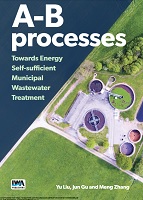
        Thumbnail
        Download PDF Viewer
        Collection
        Knowledge Unlatched (KU); KU Select 2019 STEM Frontlist
        Language
        English
        Show full item record
        Abstract
        The principle of the conventional activated sludge (CAS) for municipal wastewater treatment is primarily based on biological oxidation by which organic matters are converted to biomass and carbon dioxide. After more than 100 years’ successful application, the CAS process is receiving increasing critiques on its high energy consumption and excessive sludge generation. Currently, almost all municipal wastewater treatment plants with the CAS as a core process are being operated in an energy-negative fashion. To tackle such challenging situations, there is a need to re-examine the present wastewater treatment philosophy by developing and adopting novel process configurations and emerging technologies. The solutions going forward should rely on the ways to improve direct energy recovery from wastewater, while minimizing in-plant energy consumption. ↵↵This book begins with a critical overview of the energy situation and challenges in current municipal wastewater treatment plants, showing the necessity of the paradigm shift from removal to recovery in terms of energy and resource. As such, the concept of A-B process is discussed in detail in the book. It appears that various A-B process configurations are able to provide possible engineering solutions in which A-stage is primarily designed for COD capture with the aim for direct anaerobic treatment without producing excessive biosludge, while B-stage is designated for nitrogen removal. Making the wastewater treatment energy self-sustainable is obviously of global significance and eventually may become a game changer for the global market of the municipal wastewater reclamation technology.↵↵The principal audiences include practitioners, professionals, university researchers, undergraduate and post-graduate students who are interested and specialized in municipal wastewater treatment and process design, environmental engineering, and environmental biotechnology.
        URI
        https://library.oapen.org/handle/20.500.12657/104932
        Keywords
        Science / Environmental Science; Science / Applied Sciences; Technology & Engineering / Mining
        ISBN
        9781789060089, 9781789060089
        Publisher
        IWA Publishing
        Publisher website
        https://www.iwapublishing.com/
        Publication date and place
        2019
        Grantor
        • Knowledge Unlatched - [...]
        Classification
        Environmental science, engineering and technology
        Industrial applications of scientific research and technological innovation
        Mining technology and engineering
        Rights
        http://creativecommons.org/licenses/by-nc-nd/4.0/
        • Imported or submitted locally

        Browse

        All of OAPENSubjectsPublishersLanguagesCollections

        My Account

        LoginRegister

        Export

        Repository metadata
        Logo Oapen
        • For Librarians
        • For Publishers
        • For Researchers
        • Funders
        • Resources
        • OAPEN

        Newsletter

        • Subscribe to our newsletter
        • view our news archive

        Follow us on

        License

        • If not noted otherwise all contents are available under Attribution 4.0 International (CC BY 4.0)

        Credits

        • logo EU
        • This project received funding from the European Union's Horizon 2020 research and innovation programme under grant agreement No 683680, 810640, 871069 and 964352.

        OAPEN is based in the Netherlands, with its registered office in the National Library in The Hague.

        Director: Niels Stern

        Address:
        OAPEN Foundation
        Prins Willem-Alexanderhof 5
        2595 BE The Hague
        Postal address:
        OAPEN Foundation
        P.O. Box 90407
        2509 LK The Hague

        Websites:
        OAPEN Home: www.oapen.org
        OAPEN Library: library.oapen.org
        DOAB: www.doabooks.org


        Export search results

        The export option will allow you to export the current search results of the entered query to a file. Differen formats are available for download. To export the items, click on the button corresponding with the preferred download format.

        A logged-in user can export up to 15000 items. If you're not logged in, you can export no more than 500 items.

        To select a subset of the search results, click "Selective Export" button and make a selection of the items you want to export. The amount of items that can be exported at once is similarly restricted as the full export.

        After making a selection, click one of the export format buttons. The amount of items that will be exported is indicated in the bubble next to export format.