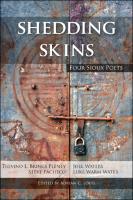
Shedding Skins
Four Sioux Poets
| dc.contributor.author | Brings Plenty, Trevino L. | |
| dc.contributor.author | Waters, Joel | |
| dc.contributor.author | Pacheco, Steve | |
| dc.contributor.author | Warm Water, Luke | |
| dc.contributor.editor | Louis, Adrian C. | |
| dc.date.accessioned | 2025-08-08T08:34:17Z | |
| dc.date.available | 2025-08-08T08:34:17Z | |
| dc.date.issued | 2008 | |
| dc.identifier | ONIX_20250808T103036_9781628955675_49 | |
| dc.identifier.uri | https://library.oapen.org/handle/20.500.12657/105204 | |
| dc.description.abstract | Here's the myth: Native Americans are people of great spiritual depth, in touch with the rhythms of the earth, rhythms that they celebrate through drumming and dancing. They love the great outdoors and are completely in tune with the natural world. They can predict the weather by glancing at the sky, or hearing a crow cry, or somehow. Who knows exactly how? The point of the myth is that Indians are, well, special. Different from white people, but in a good way. The four young male Native American poets whose work is brought together in this startling collection would probably raise high their middle fingers in salute to this myth. These guys and "guys" they are—don't buy into the myth. Their poems aren't about hunting and fishing or bonding with animal spirits. Their poems are about urban decay and homelessness, about loneliness and despair, about Payday Loans and 40-ounce beers, about getting enough to eat and too much to drink. And there is nothing romantic about their poetry, either. It is written in the vernacular of mean streets: often raw and coarse and vulgar, just like the lives it describes. Sure, they write about life on the reservation. However, for the Indians in their poems, life on the reservation is a lot like life in the city, but without the traffic. These poets are sick to death of the myth. You can feel it in their poems. These poets are bound by a common attitude as well as a common heritage. All four—Joel Waters, Steve Pacheco, Luke Warm Water, and Trevino L. Brings Plenty—are Sioux, and all four identify themselves as "Skins" (as in "Redskins"). In their poems, they grapple with their heritage, wrestling with what it means to be a Sioux and a Skin today. It's a fight to the finish. | |
| dc.language | English | |
| dc.subject.classification | thema EDItEUR::5 Interest qualifiers::5P Relating to specific groups and cultures or social and cultural interests::5PB Relating to peoples: ethnic groups, indigenous peoples, cultures and other groupings of people::5PBA Relating to Indigenous peoples | |
| dc.subject.other | Indigenous North Americans | |
| dc.title | Shedding Skins | |
| dc.title.alternative | Four Sioux Poets | |
| dc.type | book | |
| oapen.identifier.doi | 10.14321/j.ctt14bs0tn | |
| oapen.relation.isPublishedBy | 5df0f3c3-1a2c-4d1e-9f67-ce725c47ea9b | |
| oapen.relation.isFundedBy | b5941080-3f20-4864-95c6-753acff7c9f4 | |
| oapen.relation.isbn | 9781628955675 | |
| oapen.collection | Big Ten Open Books | * |
| oapen.place.publication | East Lansing | |
| oapen.grant.number | [...] | |
| oapen.grant.acronym | BTOB | |
| oapen.grant.program | Big Collection Initiative |