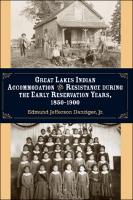
Great Lakes Indian Accommodation and Resistance during the Early Reservation Years, 1850-1900
| dc.contributor.author | Edmund Jefferson Danziger, Jr. | |
| dc.date.accessioned | 2025-08-08T08:34:51Z | |
| dc.date.available | 2025-08-08T08:34:51Z | |
| dc.date.issued | 2009 | |
| dc.identifier | ONIX_20250808T103036_9780472905522_62 | |
| dc.identifier.uri | https://library.oapen.org/handle/20.500.12657/105217 | |
| dc.description.abstract | During the four decades following the War of 1812, Great Lakes Indians were forced to surrender most of their ancestral homelands and begin refashioning their lives on reservations. The challenges Indians faced during this period could not have been greater. By century's end, settlers, frontier developers, and federal bureaucrats possessed not only economic and political power but also the bulk of the region's resources. It is little wonder that policymakers in Washington and Ottawa alike anticipated the disappearance of distinctive Indian communities within a single generation. However, these predictions have proved false as Great Lakes Indian communities, though assaulted on both sides of the international border to this day, have survived. Danziger's lively and insightful book documents the story of these Great Lakes Indians---a study not of victimization but of how Aboriginal communities and their leaders have determined their own destinies and preserved core values, lands, and identities against all odds and despite ongoing marginalization. Utilizing eyewitness accounts from the 1800s and an innovative, cross-national approach, Danziger explores not only how Native Americans adapted to their new circumstances---including attempts at horse and plow agriculture, the impact of reservation allotment, and the response to Christian evangelists---but also the ways in which the astute and resourceful Great Lakes chiefs, councils, and clan mothers fought to protect their homeland and preserve the identity of their people. Through their efforts, dreams of economic self-sufficiency and self-determination as well as the historic right to unimpeded border crossings---from one end of the Great Lakes basin to the other---were kept alive. Photo of girls at Lac du Flambeau School courtesy Wisconsin Historical Society, image 55938; photo of Ojibwa farm family at Garden River Reservation courtesy Archives of Ontario, image S 16361. | |
| dc.language | English | |
| dc.subject.classification | thema EDItEUR::5 Interest qualifiers::5P Relating to specific groups and cultures or social and cultural interests::5PB Relating to peoples: ethnic groups, indigenous peoples, cultures and other groupings of people::5PBA Relating to Indigenous peoples | |
| dc.subject.other | Indigenous North Americans | |
| dc.title | Great Lakes Indian Accommodation and Resistance during the Early Reservation Years, 1850-1900 | |
| dc.type | book | |
| oapen.identifier.doi | 10.3998/mpub.10914 | |
| oapen.relation.isPublishedBy | e07ce9b5-7a46-4096-8f0c-bc1920e3d889 | |
| oapen.relation.isFundedBy | b5941080-3f20-4864-95c6-753acff7c9f4 | |
| oapen.relation.isbn | 9780472905522 | |
| oapen.collection | Big Ten Open Books | * |
| oapen.place.publication | Ann Arbor | |
| oapen.grant.number | [...] | |
| oapen.grant.acronym | BTOB | |
| oapen.grant.program | Big Collection Initiative |