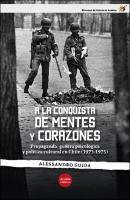
A la conquista de mentes y corazones. Propaganda, guerra psicológica y política cultural en Chile (1973-1975)
| dc.contributor.author | Guida, Alessandro | |
| dc.date.accessioned | 2025-09-17T13:07:17Z | |
| dc.date.available | 2025-09-17T13:07:17Z | |
| dc.date.issued | 2025 | |
| dc.identifier | ONIX_20250917T150322_9789566276647_4 | |
| dc.identifier.uri | https://library.oapen.org/handle/20.500.12657/106022 | |
| dc.language | Spanish | |
| dc.subject.classification | thema EDItEUR::N History and Archaeology::NH History::NHT History: specific events and topics | |
| dc.subject.other | Chile | |
| dc.subject.other | coup d'état 1973 | |
| dc.subject.other | Change of mentality | |
| dc.subject.other | propagated | |
| dc.title | A la conquista de mentes y corazones. Propaganda, guerra psicológica y política cultural en Chile (1973-1975) | |
| dc.type | book | |
| oapen.abstract.otherlanguage | When we think of dictatorships like the one established in Chile after the coup d'état that overthrew Salvador Allende on September 11, 1973, the first thing that comes to mind, in the vast majority of cases, is violence. The association with murders, disappearances, detention camps, and torture perpetrated by unscrupulous military personnel is almost immediate. The objective of this work is to highlight that the Chilean dictatorship was much more complex than a regime of terror led by gorillas dedicated to extermination. On the "home front," the population was also won over through constant manipulation, carried out through means such as propaganda, psychological warfare, the work of communications experts, influencers, psychologists, sociologists, and scientific analysis. On the "external front," fear of isolation due to the deterioration of the country's image led the regime to resort to various types of tools and strategies, which changed over time, becoming increasingly complex thanks to the contribution of foreign agencies specializing in communications and advertising. These elements invite us to problematize the study of the counterinsurgency national security regimes established in the Southern Cone with the coups d'état of the 1960s and 1970s, taking into account factors such as the ideological dimension, the search for consensus and legitimacy, the attempt to win over the population also on a moral and spiritual level, and the attempt to indoctrinate through interventions in fundamental areas such as education and culture. | |
| oapen.identifier.doi | 10.26448/ae9789566276647.144 | |
| oapen.relation.isPublishedBy | f6cb5ffd-d9ed-409f-b6f8-71eb0272e363 | |
| oapen.relation.isbn | 9789566276647 | |
| oapen.pages | 318 | |
| oapen.place.publication | Santiago, Chile |