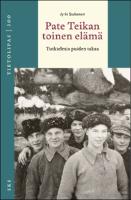
Pate Teikan toinen elämä
Tutkielmia puiden takaa
| dc.contributor.author | Siukonen, Jyrki | |
| dc.date.accessioned | 2025-09-29T14:47:13Z | |
| dc.date.available | 2025-09-29T14:47:13Z | |
| dc.date.issued | 2025 | |
| dc.identifier | ONIX_20250929T164423_9789518589672_11 | |
| dc.identifier.uri | https://library.oapen.org/handle/20.500.12657/106183 | |
| dc.language | Finnish | |
| dc.relation.ispartofseries | Tietolipas | |
| dc.subject.classification | thema EDItEUR::N History and Archaeology::NH History | |
| dc.subject.classification | thema EDItEUR::D Biography, Literature and Literary studies | |
| dc.subject.other | authors | |
| dc.subject.other | fiction and poetry | |
| dc.subject.other | fictional characters | |
| dc.subject.other | history of literature | |
| dc.subject.other | literary studies | |
| dc.subject.other | Pentti Haanpaa | |
| dc.title | Pate Teikan toinen elämä | |
| dc.title.alternative | Tutkielmia puiden takaa | |
| dc.type | book | |
| oapen.abstract.otherlanguage | In the 1920s and 30s, the young Finnish nation was sourcing wealth from its forests. Modern cellulose factories were erected at a time when trees were still being felled by hand. This divided period saw the Finnish author Pentti Haanpää (1905–1955) publish his early short stories and write his famous Depression novel Noitaympyrä (The Vicious Circle), on the pages of which still lives the image of the free Finnish lumberjack, jätkä. This research takes a fresh angle on Haanpää’s prose and his descriptions of the time, with a special emphasis on the manuscript of the posthumously published Noitaympyrä (1956). The first chapter offers a close reading of Haanpää’s early short stories from around 1925, and the second compares his fictional story of the life in a lumberjacks’ log cabin with two texts by later authors. Why is it that Haanpää, who never experienced hard forest work himself, is often considered as its best portrayer? The third chapter introduces another literary description of forest industry, namely the building of the Kaukopää cellulose factory in the industrial novel by Erkki Ilmari from 1935. The book is read against the typical framework in contemporary Soviet construction novels, and analyzed as a parallel text to Haanpää’s Noitaympyrä. The fourth chapter concentrates on the writing process of Noitaympyrä and shows that its famous ending, where the protagonist Pate Teikka plans to cross the border to the USSR, is in fact a later addition. In the original version of the narrative, rejected by all publishers at the time, Pate Teikka takes no political stance and commits suicide. In the fifth chapter Haanpää’s socialist sympathies are studied in relation to his supporter Jarno Pennanen, the editor of the Soviet-backed literary journal Kirjallisuuslehti. Pennanen had joined the illegal Finnish Communist Party and was constantly under surveillance by Finnish police intelligence. He did not succeed in sending Haanpää to Moscow in 1932 but made a long trip himself two years later and visited, among other places, the White Sea Canal, a notorious Gulag showpiece. The sixth chapter proposes a speculative reading of the ending of Noitaympyrä, based on facts about real border crossing activity in the early 1930s, when thousands of Finns went illegally to Russia with hopes of better life. What if Pate Teikka had had second thoughts? The final chapter discusses his reappearance in a 1935 short story, now again working in Finland and once again at loggerheads with the ruthless forest company. The Second Life of Pate Teikka shows that Pentti Haanpää, despite being hailed as a national author, is still understudied, especially when it comes to primary research on his manuscripts. | |
| oapen.identifier.doi | 10.21435/tl.300 | |
| oapen.relation.isPublishedBy | Finnish Literature Society / SKS [*] | |
| oapen.relation.isbn | 9789518589672 | |
| oapen.relation.isbn | 9789518589696 | |
| oapen.relation.isbn | 9789518589689 | |
| oapen.imprint | Finnish Literature Society/SKS | |
| oapen.series.number | 30 | |
| oapen.pages | 185 | |
| oapen.place.publication | Helsinki, Finland |