Logo Oapen
  • Join
    • Deposit
    • For Librarians
    • For Publishers
    • For Researchers
    • Funders
    • Resources
    • OAPEN
        View Item 
        •   OAPEN Home
        • View Item
        •   OAPEN Home
        • View Item
        JavaScript is disabled for your browser. Some features of this site may not work without it.

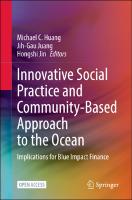
        Innovative Social Practice and Community-Based Approach to the Ocean

        Implications for Blue Impact Finance
        Thumbnail
        Download PDF Viewer
        Web Shop
        Contributor(s)
        Huang, Michael C. (editor)
        Juang, Jih-Gau (editor)
        Jin, Hongshi (editor)
        Language
        English
        Show full item record
        Abstract
        This book stands as a pioneering work, illustrating a community-based and people-centered approach to the ocean. It meticulously outlines methodologies, procedures, and evaluations of social practices initiated by universities and think tanks, rooted in the actualization of social responsibility. Its outcomes extend towards implications for blue impact finance, highlighting a dedicated commitment to fostering positive change in oceanic environments. Universities play a vital role in bridging research and education to create innovative solutions for communities as partnerships. Japan and Taiwan share similar concerns as maritime states and recognize that collaboration is the linchpin for strengthening relationships among faculty, students, and local residents, ensuring sustainability with a positive societal impact. To address this issue, the Ocean Policy Research Institute (OPRI) of the Sasakawa Peace Foundation collaborates with the Taiwan–Japan Alliance of Local Revitalization and Social Practice and the National Taiwan Ocean University. Through this joint effort, thematic case studies are selected to illuminate the methodology of impact assessment and evaluation for ocean-link initiatives within the framework of think tank–university social responsibility. This book contains four key parts: I. Methodology of Problem-solving Structure for Coastal Region; II. Challenges and Opportunities of Ocean-link Industries; III. Innovative Forms of Blue Impact; and IV. Evaluating Blue Impact from Social and Environmental Perspective. Successful experiences have been shown to rely on problem identification, assessment, and endeavor, driven by shared motivations and the establishment of trust among research institutes, universities, and communities. This is an open access book.
        URI
        https://library.oapen.org/handle/20.500.12657/107676
        Keywords
        Blue Impact Finance; People-centered Community-based Approach; Think Tank-University Social Responsibility; Blue Economy; Ocean Education; Regional Revitalization; Open Innovation for Blue Tech; Marine Protection Area; Open Access
        DOI
        10.1007/978-981-96-9104-3
        ISBN
        9789819691043, 9789819691043, 9789819691036
        Publisher
        Springer Nature
        Publisher website
        https://www.springernature.com/gp/products/books
        Publication date and place
        Singapore, 2026
        Imprint
        Springer
        Series
        Social Sciences,
        Classification
        Social work
        Political science and theory
        Project management
        Management and management techniques
        Risk assessment
        Education: examinations and assessment
        Pages
        256
        Public remark
        Funded by: Sasakawa Peace Foundation
        Rights
        http://creativecommons.org/licenses/by/4.0/
        • Imported or submitted locally

        Browse

        All of OAPENSubjectsPublishersLanguagesCollections

        My Account

        LoginRegister

        Export

        Repository metadata
        Logo Oapen
        • For Librarians
        • For Publishers
        • For Researchers
        • Funders
        • Resources
        • OAPEN

        Newsletter

        • Subscribe to our newsletter
        • view our news archive

        Follow us on

        License

        • If not noted otherwise all contents are available under Attribution 4.0 International (CC BY 4.0)

        Credits

        • logo EU
        • This project received funding from the European Union's Horizon 2020 research and innovation programme under grant agreement No 683680, 810640, 871069 and 964352.

        OAPEN is based in the Netherlands, with its registered office in the National Library in The Hague.

        Director: Niels Stern

        Address:
        OAPEN Foundation
        Prins Willem-Alexanderhof 5
        2595 BE The Hague
        Postal address:
        OAPEN Foundation
        P.O. Box 90407
        2509 LK The Hague

        Websites:
        OAPEN Home: www.oapen.org
        OAPEN Library: library.oapen.org
        DOAB: www.doabooks.org


        Export search results

        The export option will allow you to export the current search results of the entered query to a file. Differen formats are available for download. To export the items, click on the button corresponding with the preferred download format.

        A logged-in user can export up to 15000 items. If you're not logged in, you can export no more than 500 items.

        To select a subset of the search results, click "Selective Export" button and make a selection of the items you want to export. The amount of items that can be exported at once is similarly restricted as the full export.

        After making a selection, click one of the export format buttons. The amount of items that will be exported is indicated in the bubble next to export format.