
Logo Oapen
  • Join
    • Deposit
    • For Librarians
    • For Publishers
    • For Researchers
    • Funders
    • Resources
    • OAPEN
        View Item 
        •   OAPEN Home
        • View Item
        •   OAPEN Home
        • View Item
        JavaScript is disabled for your browser. Some features of this site may not work without it.

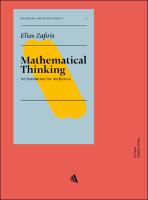
        Mathematical Thinking. An Involution for Architects
        Thumbnail
        Download PDF Viewer
        Web Shop
        Author(s)
        Zafiris, Elias
        Language
        English
        Show full item record
        Abstract
        The two most predominant characteristics of mathematical thinking are abstraction and diachronic validity. The currently dominant division between pure and applied mathematics eradicates both— how abstraction always guides method, and how the universality that pertains to mathematics constitutes transhistorical and transcultural validity. By the method guided by abstraction, this book understands a process of percolation which allows the filtering out of all irrelevant details pertaining to a particular problem, so that the invariants of this problem can be revealed, exposed, communicated, and translated to help coping with a similar problem in another situation. It is through the finding of such invariances that the diachronic validity of mathematical thinking can be enunciated beyond the writing of a linearly progressing ‘history of mathematics’, and also beyond the analytical fixation with axiomatics and foundation in a-historical manner. The proposed view on mathematical thinking, and the creativity and inventiveness inherent to it, can connect in a surprising manner current physics with computation and the rich legacy of thinking the cosmos architectonically, in philosophy and in the arts. This book guides in an introductory manner through some of the many implications that come with this proposed “involution”.
        URI
        https://library.oapen.org/handle/20.500.12657/108027
        Keywords
        Architecture; Mathematics; Philosophy; History; Architectural theory; Architectronics; Mathematical thinking
        DOI
        10.34727/2025/isbn.978-3-85448-075-4
        ISBN
        9783854480754, 9783854480754
        Publisher
        TU Wien Academic Press
        Publisher website
        https://www.tuwien.at/academicpress/
        Publication date and place
        Vienna, 2025
        Series
        Meridian Architectonics, 2
        Classification
        Theory of architecture
        Applied mathematics
        Pages
        388
        Rights
        https://creativecommons.org/licenses/by-sa/4.0/deed.de/
        • Imported or submitted locally

        Browse

        All of OAPENSubjectsPublishersLanguagesCollections

        My Account

        LoginRegister

        Export

        Repository metadata
        Logo Oapen
        • For Librarians
        • For Publishers
        • For Researchers
        • Funders
        • Resources
        • OAPEN

        Newsletter

        • Subscribe to our newsletter
        • view our news archive

        Follow us on

        License

        • If not noted otherwise all contents are available under Attribution 4.0 International (CC BY 4.0)

        Credits

        • logo EU
        • This project received funding from the European Union's Horizon 2020 research and innovation programme under grant agreement No 683680, 810640, 871069 and 964352.

        OAPEN is based in the Netherlands, with its registered office in the National Library in The Hague.

        Director: Niels Stern

        Address:
        OAPEN Foundation
        Prins Willem-Alexanderhof 5
        2595 BE The Hague
        Postal address:
        OAPEN Foundation
        P.O. Box 90407
        2509 LK The Hague

        Websites:
        OAPEN Home: www.oapen.org
        OAPEN Library: library.oapen.org
        DOAB: www.doabooks.org


        Export search results

        The export option will allow you to export the current search results of the entered query to a file. Differen formats are available for download. To export the items, click on the button corresponding with the preferred download format.

        A logged-in user can export up to 15000 items. If you're not logged in, you can export no more than 500 items.

        To select a subset of the search results, click "Selective Export" button and make a selection of the items you want to export. The amount of items that can be exported at once is similarly restricted as the full export.

        After making a selection, click one of the export format buttons. The amount of items that will be exported is indicated in the bubble next to export format.