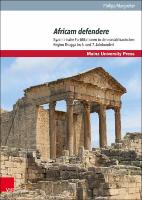
Africam defendere
Byzantinische Fortifikationen in der nordafrikanischen Region Thugga im 6. und 7. Jahrhundert
| dc.contributor.author | Margreiter, Philipp | |
| dc.date.accessioned | 2026-03-02T11:21:22Z | |
| dc.date.available | 2026-03-02T11:21:22Z | |
| dc.date.issued | 2025 | |
| dc.identifier.uri | https://oapen-dev.siscern.org/handle/20.500.12657/108709 | |
| dc.language | German | |
| dc.relation.ispartofseries | Byzanz und die euromediterranen Kriegskulturen | |
| dc.subject.classification | thema EDItEUR::N History and Archaeology::NH History::NHC Ancient history | |
| dc.subject.classification | thema EDItEUR::J Society and Social Sciences::JW Warfare and defence::JWT Military institutions | |
| dc.subject.classification | thema EDItEUR::N History and Archaeology::NH History::NHH African history::NHHA African history: pre-colonial period | |
| dc.subject.classification | thema EDItEUR::N History and Archaeology::NH History::NHW Military history::NHWA Ancient warfare | |
| dc.subject.classification | thema EDItEUR::N History and Archaeology::NK Archaeology::NKD Archaeology by period / region::NKDS Archaeological sites | |
| dc.subject.other | Archäologie | |
| dc.subject.other | Nordafrika | |
| dc.subject.other | Spätantike | |
| dc.subject.other | Byzanz | |
| dc.subject.other | Krieg | |
| dc.subject.other | Konfliktlandschaften | |
| dc.subject.other | Römisches Reich | |
| dc.subject.other | Römische Städte | |
| dc.subject.other | Tunesien | |
| dc.subject.other | Festung | |
| dc.title | Africam defendere | |
| dc.title.alternative | Byzantinische Fortifikationen in der nordafrikanischen Region Thugga im 6. und 7. Jahrhundert | |
| dc.type | book | |
| oapen.abstract.otherlanguage | Im 6. und 7. Jahrhundert entstand in der nordafrikanischen Region Thugga (heutiges Tunesien) durch den Bau von Festungen, Fortifikationen, Stadtmauern und Wachtürmen eine befestigte Landschaft. Der urbane Ballungsraum des Untersuchungsgebiets gehörte zu den reichsten Regionen des römischen Nordafrikas. Philipp Margreiter zeigt auf, welche Rollen und Nutzungsmöglichkeiten die verschiedenen Fortifikationen in der Transformation des spätantiken Siedlungswesens spielten und welche Anpassungsstrategien daraus folgten. Daneben untersucht er bei den einzelnen Festungen Bauprozesse und Materialressourcen anhand von Spolien, um Auswahl- und Entscheidungsprozesse während der Errichtung nachvollziehen zu können. Damit zeigt dieser Band erstmals die Einbettung byzantinischer Fortifikationen einer nordafrikanischen Region in eine landschaftsarchäologische Untersuchung. Diese Herangehensweise ist dabei auch auf andere Regionen des byzantinischen Nordafrikas anwendbar und kann für zukünftige archäologische Forschungsvorhaben im heutigen Maghreb eine Orientierung sein. This book examines the development of a fortified landscape in the North African region of Thugga (present-day Tunisia) through the construction of forts, fortifications, city walls and watchtowers in the 6th and 7th centuries. The urban agglomeration of the study area included numerous towns, village settlements and agricultural homesteads as well as imperial estates and was one of the richest regions of Roman North Africa. The book shows the role and possible uses of the various fortifications in the transformation of the Late Antique settlement system and the resulting adaptation strategies. It also examines the construction processes and material resources of the individual fortifications on the basis of spolia in order to understand the selection and decision-making processes during their construction. This is the first book to show how Byzantine fortifications in a North African region were embedded in a landscape archaeological study. This approach can be applied to other regions of Byzantine North Africa and should serve as a model for future archaeological research projects in the contemporary Maghreb. | |
| oapen.identifier.doi | 10.14220/9783737019057 | |
| oapen.relation.isPublishedBy | 99f69d33-d922-4714-954e-df33c16d5198 | |
| oapen.relation.isbn | 9783737019057 | |
| oapen.series.number | Band 007 | |
| oapen.pages | 618 | |
| oapen.place.publication | Göttingen |