
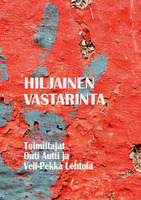
Hiljainen vastarinta
 Download
Contributor(s)
Autti, Outi (editor)
Lehtola, Veli-Pekka (editor)
Language
FinnishAbstract
"This book provides the reader with understanding of the phenomenon of silent resistance, collecting and presenting research on it. Regulating, governing or controlling human activity often generates open resistance, which has been studied from the points of view of democracy, civil disobedience or political activism, for example. However, power relations and conflicts can also involve another kind of resistance, which may not necessarily even be recognised as resistance at first. It can be called silent, passive, invisible or everyday resistance. Silent resistance is a way of the subjugated or otherwise marginalised to challenge the dominant rules or systems. Because it does not proclaim resistance but rather tries to stay out of publicity, it is risk-free and low-profile activity that is seemingly non-political – and you can get away with it.
Silent resistance can take many different forms: it may appear, for example, as silence and grumbling, isolation, avoiding and hindering issues or shifting attention to something irrelevant. The importance of everyday resistance rises from the signals of small networks in a situation where open confrontation is not possible or desired, but total inactivity is not an option either. Moreover, silent resistance remaining in the margin cannot be considered separate from open resistance, but as an important part in the process of realising more open resistance. Although power relations serve as the event framework of the phenomenon, silent resistance is a weapon not only in the hands of the subjugated. Its tactics can also be used by those who hold power.
With the articles in the book, the reader can follow the most diverse situations of silent resistance through both historical and contemporary events. The cases outline different forms of silent resistance, as well as its mechanisms and motives. The articles in the collection reveal aspects of sociology, cultural anthropology, cultural research, youth research and historical research. This emphasises the wide spectrum of silent resistance, its loudness and multidisciplinary character.
" "Kirja tekee näkyväksi vähän käsiteltyä hiljaisen vastarinnan ilmiötä sekä kokoaa yhteen ja esittelee sitä koskevaa tutkimusta. Kun ihmisen toimintaa säädellään, hallitaan tai kontrolloidaan, ilmenee usein myös avointa vastarintaa, jota on tutkittu esimerkiksi demokratian toteutumisen, kansalaistottelemattomuuden tai poliittisen aktivismin näkökulmista. Valta-asetelmiin ja konflikteihin voi kuitenkin liittyä myös toisenlaista vastarintaa, jota ei välttämättä ensin edes huomata vastarinnaksi. Sitä voidaan kutsua hiljaiseksi, passiiviseksi, näkymättömäksi tai arkipäivän vastarinnaksi. Hiljainen vastarinta on alistettujen tai muuten marginaalisiksi jääneiden tapa asettua poikkiteloin hallitsevien sääntöjen tai järjestelmien kanssa. Koska se ei julistaudu vastarinnaksi, vaan pikemminkin pyrkii pysymään poissa julkisuudesta, se on riskitöntä matalan profiilin toimintaa, joka on näennäisesti epäpoliittista ja josta ei jää kiinni.
Hiljainen vastarinta voi saada monia erilaisia muotoja: se saattaa näyttäytyä esimerkiksi vaikenemisena ja jurnuttamisena, ulkopuolelle jättäytymisenä, asioiden välttämisenä, niiden vaikeuttamisena tai huomion siirtämisenä epäolennaiseen. Arkipäivän vastarinnan merkitys nousee pienten verkostojen signaaleista tilanteessa, jossa ei kyetä tai haluta lähteä julkiseen vastakkainasetteluun, mutta ei myöskään haluta pysyä täysin passiivisina. Marginaaliin jäävää hiljaista vastarintaa ei myöskään voida nähdä erillisenä avoimesta vastarinnasta, vaan se on tärkeä osa avoimemman vastarinnan aktualisoitumisen prosessia. Vaikka valtasuhteet toimivat ilmiön tapahtumakehyksinä, hiljainen vastarinta ei ole ainoastaan alistettujen toimintaa. Sen taktiikoita voivat käyttää myös valtaapitävät.
Kirjan artikkeleiden mukana pääsemme seuraamaan mitä moninaisimpia hiljaisen vastarinnan tapahtumatilanteita sekä historiallisten että nykypäivän tapahtumien avulla. Erilaiset tapaukset avaavat ja jäsentävät hiljaisen vastarinnan esiintymismuotoja, samoin kuin sen mekanismeja ja motiiveja. Kokoelman artikkeleissa tulevat esiin sosiologian, kulttuuriantropologian, kulttuurintutkimuksen, nuorisotutkimuksen ja historiantutkimuksen näkökulmat. Tämä korostaa hiljaisen vastarinnan laajaa kirjoa, sen äänekkyyttä ja monialaisuutta. "
Keywords
everyday resistance; power relations; passive resistance; resistance; silent resistance; arkipäivän vastarinta; hiljainen vastarinta; passiivinen vastarinta; valta, vastarinta; rokotteet; kriittisyys; saamelaiset; sotavangit; inkeriläiset; koulukodit; yrittäjyys; joukkueurheilu; partisaanit; jatkosota; vähemmistöt; historia; Suomi; Viro; NeuvostoliittoOCN
1100530488Publisher
Tampere University PressPublisher website
https://edition.fi/tupPublication date and place
Tampere, 2019Classification
History: specific events and topics
Society and culture: general