
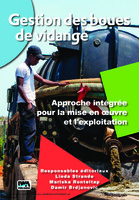
Gestion des Boues de Vidange
Approche intégrée pour la mise en œuvre et l’exploitation
 Download
Contributor(s)
Strande, Linda (editor)
Ronteltap, Mariska (editor)
Brdjanovic, Damir (editor)
Language
FrenchAbstract
"This book is the French Translation of Faecal Sludge Management: Systems Approach for Implementation and Operation.
It is estimated that literally billions of residents in urban and peri-urban areas of Africa, Asia, and Latin America are served by onsite sanitation systems (e.g. various types of latrines and septic tanks). Until recently, the management of faecal sludge from these onsite systems has been grossly neglected, partially as a result of them being considered temporary solutions until sewer-based systems could be implemented. However, the perception of onsite or decentralized sanitation technologies for urban areas is gradually changing, and is increasingly being considered as long-term, sustainable options in urban areas, especially in low- and middle-income countries that lack sewer infrastructures. This is the first book dedicated to faecal sludge management. It compiles the current state of knowledge of the rapidly evolving field of faecal sludge management, and presents an integrated approach that includes technology, management, and planning based on Sandecs 20 years of experience in the field.
Faecal Sludge Management: Systems Approach for Implementation and Operation addresses the organization of the entire faecal sludge management service chain, from the collection and transport of sludge, and the current state of knowledge of treatment options, to the final end use or disposal of treated sludge. The book also presents important factors to consider when evaluating and upscaling new treatment technology options.
The book is designed for undergraduate and graduate students, and engineers and practitioners in the field who have some basic knowledge of environmental and/or wastewater engineering." "Plus d'un milliard de personnes dans les zones urbaines et périurbaines d'Afrique, d'Asie et d'Amérique latine sont desservies par des dispositifs d'assainissement à la parcelle. La gestion des boues extraites de ces dispositifs, les « boues de vidange », a été jusqu'à présent grandement négligée. Les ressources financières sont souvent insuffisantes et les dispositifs d'assainissement à la parcelle ont tendance à être considérés comme des solutions temporaires, dan l'attente de la mise en place de réseaux d'égouts. Cependant , force est de constater que l'assainissement à la parcelle est là pour durer, soit en tant que solution autonome permanente, soit en association avec des systèmes égouts-station. La gestion adéquate des boues de vidange issues des dispositifs d'assainissement des ménages est un impératif pour la protection de Ia santé humaine et de l'environnement.
Cet ouvrage est le premier à être consacré à la gestion des boues de vidange. II rassemble l'état actuel des connaissances de ce domaine qui évolue rapidement, et propose une approche intégrée qui lie les composantes technologiques, organisationnelles et de planification. II aborde la planification et l'organisation de l'ensemble de la filière de gestion des boues de vidange depuis la collecte et l'évacuation des boues jusqu'aux solutions de traitement et à l'utilisation finale ou la mise en dépôt des boues traitées. En plus de fournir des éléments fondamentaux sur le traitement et une description des technologies existantes, l'ouvrage présente en détail les aspects opérationnels, institutionnels et financiers. II propose également une méthode de planification d'un projet de gestion des boues de vidange à l'échelle d'une ville avec l'ensemble des parties prenantes."
Keywords
wastewater; reuse; sludgeDOI
10.2166/9781780409801ISBN
9781780409801OCN
1082958481Publisher
IWA PublishingPublisher website
https://www.iwapublishing.com/Publication date and place
2018Classification
Industrial applications of scientific research and technological innovation
Water supply and treatment