
Logo Oapen
  • Join
    • Deposit
    • For Librarians
    • For Publishers
    • For Researchers
    • Funders
    • Resources
    • OAPEN
        View Item 
        •   OAPEN Home
        • View Item
        •   OAPEN Home
        • View Item
        JavaScript is disabled for your browser. Some features of this site may not work without it.

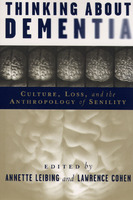
        Thinking About Dementia

        Culture, Loss, and the Anthropology of Senility
        Thumbnail
        Download PDF Viewer
        Author(s)
        Leibing, Annette
        Cohen, Lawrence
        Collection
        Knowledge Unlatched (KU); KU Select 2017: Backlist Collection
        Number
        101109
        Language
        English
        Show full item record
        Abstract
        Bringing together essays by nineteen respected scholars, this volume approaches dementia from a variety of angles, exploring its historical, psychological, and philosophical implications. The authors employ a cross-cultural perspective that is based on ethnographic fieldwork and focuses on questions of age, mind, voice, self, loss, temporality, memory, and affect. Taken together, the essays make four important and interrelated contributions to our understanding of the mental status of the elderly. First, cross-cultural data show that the aging process, while biologically influenced, is also culturally constructed. Second, ethnographic reports raise questions about the diagnostic criteria used for defining the elderly as demented. Third, case studies show how a diagnosis affects a patient's treatment in both clinical and familial settings. Finally, the collection highlights the gap that separates current biological understandings of aging from its cultural meanings.
        URI
        http://library.oapen.org/handle/20.500.12657/30773
        Keywords
        Anthropology; dementia; age; anthropology; health; medicine; Alzheimer's disease
        DOI
        10.2307/j.ctt5hjbhp
        ISBN
        9780813538020
        OCN
        71842945
        Publisher
        Rutgers University Press
        Publisher website
        https://www.rutgersuniversitypress.org/
        Publication date and place
        New Brunswick, 2006-01-01
        Grantor
        • Knowledge Unlatched - 101109 - KU Select 2017: Backlist Collection
        Series
        Studies in Medical Anthropology,
        Public remark
        Relevant Wikipedia pages: Alzheimer's disease - https://en.wikipedia.org/wiki/Alzheimer%27s_disease; Dementia - https://en.wikipedia.org/wiki/Dementia
        Rights
        https://creativecommons.org/licenses/by-nc-nd/4.0/legalcode
        • Imported or submitted locally

        Browse

        All of OAPENSubjectsPublishersLanguagesCollections

        My Account

        LoginRegister

        Export

        Repository metadata
        Logo Oapen
        • For Librarians
        • For Publishers
        • For Researchers
        • Funders
        • Resources
        • OAPEN

        Newsletter

        • Subscribe to our newsletter
        • view our news archive

        Follow us on

        License

        • If not noted otherwise all contents are available under Attribution 4.0 International (CC BY 4.0)

        Credits

        • logo EU
        • This project received funding from the European Union's Horizon 2020 research and innovation programme under grant agreement No 683680, 810640, 871069 and 964352.

        OAPEN is based in the Netherlands, with its registered office in the National Library in The Hague.

        Director: Niels Stern

        Address:
        OAPEN Foundation
        Prins Willem-Alexanderhof 5
        2595 BE The Hague
        Postal address:
        OAPEN Foundation
        P.O. Box 90407
        2509 LK The Hague

        Websites:
        OAPEN Home: www.oapen.org
        OAPEN Library: library.oapen.org
        DOAB: www.doabooks.org


        Export search results

        The export option will allow you to export the current search results of the entered query to a file. Differen formats are available for download. To export the items, click on the button corresponding with the preferred download format.

        A logged-in user can export up to 15000 items. If you're not logged in, you can export no more than 500 items.

        To select a subset of the search results, click "Selective Export" button and make a selection of the items you want to export. The amount of items that can be exported at once is similarly restricted as the full export.

        After making a selection, click one of the export format buttons. The amount of items that will be exported is indicated in the bubble next to export format.