
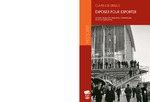
Exposer pour exporter. Culture visuelle et expansion commerciale en Suisse (1908-1939)
 Download
 Web Shop
Collection
OAPEN-CH 1st Call; Swiss National Science Foundation (SNF)Language
FrenchAbstract
In the early 20th Century, exhibitions and international fairs were a favoured field for Swiss businesses that wished to conquer new territories in foreign markets. The way in which Switzerland was represented abroad challenged traditional regional construction by substituting more geometrical lines, thereby replacing the ‘chalet style’. The ‘genesis’ of the Swiss style of exhibition, between commercial expansion and modern architecture, is depicted here beyond that of a purely institutional history, providing a new viewpoint into its economic and artistic aspects. Particular atten-tion is given to the role of certain ‘intermediaries’ in the creation and diffusion of a visual culture to a commercial action. Durant la première moitié du XXe siècle, les expositions et les foires internationales constituent un terrain d’affrontement privilégié entre les différents acteurs de la politique d’exposition. Alors que les entreprises suisses cherchent à conquérir de nouvelles positions sur les marchés extérieurs, la manière de représenter la Suisse à l’étranger fait particulièrement débat. Aux traditionnelles constructions régional-istes se substituent des aménagements aux lignes épurées, conçus selon les princi-pes fonctionnalistes de la « construction nouvelle ». Désigné dès le milieu des années 1930 sous le terme de « style suisse », ce nouveau visage de l’architecture d’exposition, simple et rationnel, rompt avec le vocabulaire formel du « style chalet », si souvent privilégié dans les expositions universelles du tournant du XXe siècle. Loin de constituer un phénomène isolé, ces reconfigurations témoignent d’un mouvement plus large de rationalisation de l’organisation commerciale. Dans le sillage de la Première Guerre mondiale, des publications spécialisées aux foires modernes, l’efficience visuelle devient en effet un instrument incontournable de la « lutte pour les débouchés » commerciaux.
La genèse du « style suisse » d’exposition, conçue comme le fruit d’une collabora-tion étroite entre les acteurs de l’expansion commerciale et du mouvement de l’architecture moderne, est au coeur du présent ouvrage. Au-delà d’une histoire purement institutionnelle, ce livre apporte un éclairage inédit sur les enjeux économiques et artistiques de la politique d’exposition. Il prête une attention par-ticulière au rôle de certains « passeurs » dans la formulation et la diffusion d’une culture visuelle de l’action commerciale.
Keywords
economic and heritage organisations; organisations économiques et patronales; politique d'exposition; exhibition policy; swiss style exhibitions; commercial expansion; expansion commerciale; entre-deux-guerres; between two wars; industrial exhibition; style suisse d’exposition; expositions industriellesDOI
10.26530/OAPEN_594271ISBN
9782889300488OCN
1030819299Publisher website
https://alphil.com/Publication date and place
Neuch, 2015Classification
Social and cultural history
Industrialisation and industrial history