
Logo Oapen
  • Join
    • Deposit
    • For Librarians
    • For Publishers
    • For Researchers
    • Funders
    • Resources
    • OAPEN
        View Item 
        •   OAPEN Home
        • View Item
        •   OAPEN Home
        • View Item
        JavaScript is disabled for your browser. Some features of this site may not work without it.

        Die synchronisierte Stadt

        Öffentliche Uhren und Zeitwahrnehmung, Wien 1850 bis heute
        Thumbnail
        Download PDF Viewer
        Author(s)
        Payer, Peter
        Collection
        Austrian Science Fund (FWF)
        Language
        German
        Show full item record
        Abstract
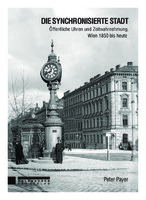
        The work at hand explores the successive chronometrisation of public space using the example of Viennas public clocks from the middle of the 19th century until today.The need for knowing the exact time steadily increased since the middle of the 19th century. As two centuries ago the clocks had only hour hands, the minute hands soon became essential. Industrialisation, urbanisation, but primarily the rapid development of the railroading promoted the trend towards the modern time management of the society. Schedules demanded a higher precision of time specification; circulations of goods and persons had to be adjusted to each other; professional and private activities became standardised, tacted and adjusted to the abstract rhythm of the clocks. The knowledge about the social and economic value of time became a central criterion for the level of western civilisation. Especially the members of the middle-class got more and more used to a chronometer. It was a high goodness for them to use their time as efficient as possible. Pocket watches and wrist watches became familiar and also the number of public clocks continously increased. Especially the more and more complex organised cities became pioneers in the sphere of public timepiece. The work at hand explores, for the first time in the German-speaking historical research, the successive chronometrisation of public space using the example of Vienna from the middle of the 19th century until today. On the one hand it deals with the “exterior chronometrisation“, that is the visible aggregation of the infrastructure of time and the construction of different kinds of clocks. Spatial, architectural and design related aspects were argued, contexts of technical history as the search for the ideal drive system and of the political and representative functions of public clocks were discussed. On the other hand it deals with the “interior chronometrisation“ which means social, psychological and cultural aspects of the perception of time and their contextualisation in phenomena of scaling and standardisation on a local basis to a world scale. The actual trend of visualising public time to the split second marks the (temporary) end of the development which shows the speedup of all areas of life in a visible and sensible way.
         
        Das vorliegende Werk beleuchtet das vielschichtige Wechselverhältnis von Stadt und Zeit. Ursachen und Auswirkungen der urbanen „Chronometrisierung“ werden am Beispiel der öffentlichen Uhren Wiens von der Mitte des 19. Jahrhunderts bis heute dargestellt.
         
        URI
        http://library.oapen.org/handle/20.500.12657/33096
        Keywords
        Public clocks; Synchronisation of time; Urban history; Perception of time; History of Vienna; European history; Öffentliche Uhren; Synchronisation; Zeitwahrnehmung; Stadtgeschichte; Geschichte von Wien; Europäische Geschichte; Wiener Würfeluhr; Zifferblatt
        DOI
        10.15661/mono/geschichtel/synchro-stadt
        ISBN
        9783902868534
        OCN
        1030821508
        Publisher
        Holzhausen
        Publisher website
        https://www.verlagholzhausen.at/
        Publication date and place
        2015
        Grantor
        • Austrian Science Fund - PUB 286
        Classification
        History
        Pages
        240
        Public remark
        Relevant Wikipedia pages: Wien - https://de.wikipedia.org/wiki/Wien; Wiener Würfeluhr - https://de.wikipedia.org/wiki/Wiener_W%C3%BCrfeluhr; Zifferblatt - https://de.wikipedia.org/wiki/Zifferblatt
        • Imported or submitted locally

        Browse

        All of OAPENSubjectsPublishersLanguagesCollections

        My Account

        LoginRegister

        Export

        Repository metadata
        Logo Oapen
        • For Librarians
        • For Publishers
        • For Researchers
        • Funders
        • Resources
        • OAPEN

        Newsletter

        • Subscribe to our newsletter
        • view our news archive

        Follow us on

        License

        • If not noted otherwise all contents are available under Attribution 4.0 International (CC BY 4.0)

        Credits

        • logo EU
        • This project received funding from the European Union's Horizon 2020 research and innovation programme under grant agreement No 683680, 810640, 871069 and 964352.

        OAPEN is based in the Netherlands, with its registered office in the National Library in The Hague.

        Director: Niels Stern

        Address:
        OAPEN Foundation
        Prins Willem-Alexanderhof 5
        2595 BE The Hague
        Postal address:
        OAPEN Foundation
        P.O. Box 90407
        2509 LK The Hague

        Websites:
        OAPEN Home: www.oapen.org
        OAPEN Library: library.oapen.org
        DOAB: www.doabooks.org


        Export search results

        The export option will allow you to export the current search results of the entered query to a file. Differen formats are available for download. To export the items, click on the button corresponding with the preferred download format.

        A logged-in user can export up to 15000 items. If you're not logged in, you can export no more than 500 items.

        To select a subset of the search results, click "Selective Export" button and make a selection of the items you want to export. The amount of items that can be exported at once is similarly restricted as the full export.

        After making a selection, click one of the export format buttons. The amount of items that will be exported is indicated in the bubble next to export format.