
Die orientalischen Knüpfteppiche im MAK
 Download
Contributor(s)
Noever, Peter (editor)
Collection
Austrian Science Fund (FWF)Language
GermanAbstract
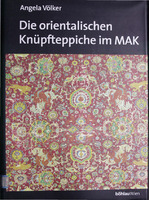
On account of its focus on unique 16th- and 17th-century Safavid (Persia, Iran) and Mamluk (Egypt, Kairo) carpets and their specific provenances, the collection of Oriental carpets of the MAK—Austrian Museum of Applied Arts / Contemporary Art in Vienna—is one of the most famous of its kind. However, the museum never appointed a specialized curator for its Orient Collection; this is perhaps one of the reasons why an inventory catalog did not appear until 2001. Most of the world-famous pieces originally belonged to the Imperial House of Habsburg and ultimately found their way into the museum after the end of the monarchy. In 1868, the museum itself began collecting in this sector. The carpets from a third source, the “Kaiserliches Königliches Handels Museum” [Imperial Royal Austrian Trade Museum], were purchased in 1907. This diverse background has had a formative influence on the specific structure of the Vienna collection.
Mamluk Carpets are among the highlights of the Viennese collection, especially celebrated for the sole silk Mamluk Carpet existing in the world today. Equally famous and precious are the 16th-century silk Hunting Carpet, a Herat Scrolling Vine and Animal Carpet, a so-called Portuguese Carpet, several Isfahan carpets, carpets from the Ottoman court workshop, among them the Vienna niche rug and an Indian landscape carpet, also the renowned Indian Millefleur carpet. The catalogue contains the one hundred-and-fifty pieces from the Vienna collection starting with five Mamluk Carpets, followed by five Ottoman pieces (Turkey, Istanbul), one small so-called chessboard carpet, nineteen Anatolian carpets and fifteen Iranian carpets from different regions. There are four Indian rugs and rug fragments and seventeen rugs from Central Asia, also one Moroccan piece.
The catalogue meticulously characterizes every carpet and locates and dates every piece. It states the provenance and measurements, also important technical details such as the thread material of warp, weft and knots, the knot count, and the condition of sides and ends of each rug. Every carpet is shown in full length. The most important ones are pictured with several details. The introduction describes the history of the Vienna Carpet Collection, followed by extensive captions to every carpet in the collection. The catalogue continues with a list of lost pieces, a glossary, an extensive bibliography, and finishes with the concordance of the catalogue entries with the acquisition numbers. Der vorliegende Katalog der orientalischen Knüpfteppiche des Österreichischen Museums für angewandte Kunst (MAK) ist der erste Katalog, der zu dem wertvollen Bestand der Textilsammlung des Museums erscheint. 150 Knüpfteppiche aus Ägypten, der Türkei, aus Syrien, Persien und Indien, dem Kaukasus und aus Zentralasien werden beschrieben und entsprechend der aktuellen Forschungsergebnisse wissenschaftlich bestimmt sowie technisch, ihrem Material und ihrer Knüpfung nach analysiert. Neben einer zusammenfassenden Beschreibung wird jeder Teppich in seinen historischen, lokalen, zeitlichen, formalen und technischen Zusammenhang eingeordnet und mit Orientteppichen in anderen Sammlungen verglichen. Die Einleitung beschreibt die sehr spezifische Sammlungsgeschichte, der ein Katalog der 150 Teppiche nach regionaler und chronologischer Zugehörigkeit folgt. Diesem ist eine umfangreiche Bibliographie angefügt. Glossar, Konkordanz nach Inventarnummern und Register runden das Werk ab. Der weltberühmte, in seiner Gesamtheit aber bislang unbekannte Bestand an orientalischen Knüpfteppichen der Wiener Sammlung wird so bearbeitet und vorgestellt und vermittelt ein präzises und dem aktuellen Forschungsstand entsprechendes Bild der Wiener Orientteppichsammlung.
Keywords
Safavid carpet; Mamluk carpet; Anatolian carpet; Ottoman carpet; MAK; Habsburg; Vienna Carpet Collection; Museums für angewandte Kunst; Knüpfteppiche; Bordüre; Gebetsteppich; Isfahan; Kelim; Medaillon (Ornament); Osmanisches Reich; Perserteppich; WienDOI
10.26530/oapen_473031OCN
1030821599Publication date and place
2001Grantor
Imprint
BöhlauClassification
The Arts