Logo Oapen
  • Join
    • Deposit
    • For Librarians
    • For Publishers
    • For Researchers
    • Funders
    • Resources
    • OAPEN
        View Item 
        •   OAPEN Home
        • View Item
        •   OAPEN Home
        • View Item
        JavaScript is disabled for your browser. Some features of this site may not work without it.

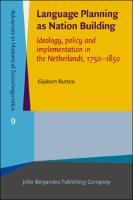
        Language Planning as Nation Building

        Ideology, policy and implementation in the Netherlands, 1750–1850
        Thumbnail
        Download PDF Viewer
        Author(s)
        Rutten, Gijsbert
        Collection
        Dutch Research Council (NWO); Dutch Research Council (NWO)
        Language
        English
        Show full item record
        Abstract
        The decades around 1800 constitute the seminal period of European nationalism. The linguistic corollary of this was the rise of standard language ideology, from Finland to Spain, and from Iceland to the Habsburg Empire. Amidst these international events, the case of Dutch in the Netherlands offers a unique example. After the rise of the ideology from the 1750s onwards, the new discourse of one language–one nation was swiftly transformed into concrete top-down policies aimed at the dissemination of the newly devised standard language across the entire population of the newly established Dutch nation-state. Thus, the Dutch case offers an exciting perspective on the concomitant rise of cultural nationalism, national language planning and standard language ideology. This study offers a comprehensive yet detailed analysis of these phenomena by focussing on the ideology underpinning the new language policy, the institutionalisation of this ideology in metalinguistic discourse, the implementation of the policy in education, and the effects of the policy on actual language use.
        URI
        http://library.oapen.org/handle/20.500.12657/39443
        Keywords
        historical linguistics; history; German linguistics; sociolinguistics and dialectology
        DOI
        10.1075/ahs.9
        ISBN
        9789027202406
        Publisher
        John Benjamins Publishing Company
        Publisher website
        https://benjamins.com/content/home
        Publication date and place
        2019
        Grantor
        • Nederlandse Organisatie voor Wetenschappelijk Onderzoek
        • Nederlandse Organisatie voor Wetenschappelijk Onderzoek
        Series
        Advances in Historical Sociolinguistics (AHS), 9
        Classification
        Linguistics
        Sociolinguistics
        Pages
        324
        Rights
        https://creativecommons.org/licenses/by-nc-nd/4.0/
        • Imported or submitted locally

        Browse

        All of OAPENSubjectsPublishersLanguagesCollections

        My Account

        LoginRegister

        Export

        Repository metadata
        Logo Oapen
        • For Librarians
        • For Publishers
        • For Researchers
        • Funders
        • Resources
        • OAPEN

        Newsletter

        • Subscribe to our newsletter
        • view our news archive

        Follow us on

        License

        • If not noted otherwise all contents are available under Attribution 4.0 International (CC BY 4.0)

        Credits

        • logo EU
        • This project received funding from the European Union's Horizon 2020 research and innovation programme under grant agreement No 683680, 810640, 871069 and 964352.

        OAPEN is based in the Netherlands, with its registered office in the National Library in The Hague.

        Director: Niels Stern

        Address:
        OAPEN Foundation
        Prins Willem-Alexanderhof 5
        2595 BE The Hague
        Postal address:
        OAPEN Foundation
        P.O. Box 90407
        2509 LK The Hague

        Websites:
        OAPEN Home: www.oapen.org
        OAPEN Library: library.oapen.org
        DOAB: www.doabooks.org


        Export search results

        The export option will allow you to export the current search results of the entered query to a file. Differen formats are available for download. To export the items, click on the button corresponding with the preferred download format.

        A logged-in user can export up to 15000 items. If you're not logged in, you can export no more than 500 items.

        To select a subset of the search results, click "Selective Export" button and make a selection of the items you want to export. The amount of items that can be exported at once is similarly restricted as the full export.

        After making a selection, click one of the export format buttons. The amount of items that will be exported is indicated in the bubble next to export format.