
Logo Oapen
  • Join
    • Deposit
    • For Librarians
    • For Publishers
    • For Researchers
    • Funders
    • Resources
    • OAPEN
        View Item 
        •   OAPEN Home
        • View Item
        •   OAPEN Home
        • View Item
        JavaScript is disabled for your browser. Some features of this site may not work without it.

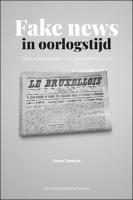
        Fake news in oorlogstijd

        Duitse mediamanipulatie en de Flamenpolitik (1914-1915)
        Thumbnail
        Download PDF Viewer
        Web Shop
        Author(s)
        Yammine, Bruno
        Language
        Dutch
        Show full item record
        Abstract
        During the First World War, the German occupier tried to split Belgium internally. This was done by pursuing a Flamenpolitik, a policy aimed at scaring the Flemish, or at least the Flemish movement, against Belgium. That worked, because a small number of Flemish supporters, the so-called activists, did indeed collaborate. From the late summer of 1914, Berlin in the occupied country would incessantly bombard the Flemish movement with a large-scale media campaign. The German services, supported by their Austrian allies, mainly made use of pamphlets and the written press, not only in Belgium but also in the neutral Netherlands. In the summer of 1915 activism was a fact: an anti-Belgian Flemish nationalism, the consequences of which have been felt to date, had seen the light of day. The propaganda underlying it was so ingenious and clever that it not only convinced contemporaries, but still misleads historians even more than a century later. It is a fine example of “fake news” avant la lettre.
         
        Tijdens de Eerste Wereldoorlog probeerde de Duitse bezetter België intern te splijten. Dat gebeurde door het voeren van een Flamenpolitik, een beleid dat erop gericht was de Vlamingen of in elk geval de Vlaamse beweging in het harnas te jagen tegen België. Dat lukte, want een klein deel Vlaamsgezinden, de zogenaamde activisten, collaboreerde inderdaad. Vanaf de nazomer van 1914 zou Berlijn in het bezette land de Vlaamse beweging onophoudelijk bestoken met een grootscheepse mediacampagne. De Duitse diensten, gesteund door hun Oostenrijkse bondgenoten, maakten daarbij vooral gebruik van vlugschriften en de geschreven pers, niet alleen in België maar ook in het neutrale Nederland. In de zomer van 1915 was het activisme een feit: een anti-Belgisch Vlaams-nationalisme, waarvan de gevolgen tot op heden voelbaar zijn, had het daglicht gezien. De propaganda die eraan ten grondslag lag was zó vernuftig en ingenieus dat ze niet alleen tijdgenoten overtuigde, maar zelfs meer dan een eeuw later nog steeds historici misleidt. Het is een mooi staaltje van “fake news” avant la lettre.
         
        URI
        https://library.oapen.org/handle/20.500.12657/47362
        Keywords
        Flamenpolitik;Propaganda;Fake news;Activisme;Eerste Wereldoorlog;Nationalisme;Groot-Nederland;Frontbeweging;Völkisch; first world war
        DOI
        10.11116/9789461663788
        ISBN
        9789461663788, 9789462702707, 9789461663795
        Publisher
        Leuven University Press
        Publisher website
        https://lup.be/
        Publication date and place
        Leuven, 2021
        Grantor
        • KU Leuven
        Classification
        Local history
        First World War
        c 1914 to c 1918 (World War One period)
        Media studies
        Pages
        392
        Public remark
        Funder name: KU Leuven Fund for Fair Open Access/ Funding program name: Universitaire Stichting van België
        Rights
        https://creativecommons.org/licenses/by-nc-nd/4.0/
        • Imported or submitted locally

        Browse

        All of OAPENSubjectsPublishersLanguagesCollections

        My Account

        LoginRegister

        Export

        Repository metadata
        Logo Oapen
        • For Librarians
        • For Publishers
        • For Researchers
        • Funders
        • Resources
        • OAPEN

        Newsletter

        • Subscribe to our newsletter
        • view our news archive

        Follow us on

        License

        • If not noted otherwise all contents are available under Attribution 4.0 International (CC BY 4.0)

        Credits

        • logo EU
        • This project received funding from the European Union's Horizon 2020 research and innovation programme under grant agreement No 683680, 810640, 871069 and 964352.

        OAPEN is based in the Netherlands, with its registered office in the National Library in The Hague.

        Director: Niels Stern

        Address:
        OAPEN Foundation
        Prins Willem-Alexanderhof 5
        2595 BE The Hague
        Postal address:
        OAPEN Foundation
        P.O. Box 90407
        2509 LK The Hague

        Websites:
        OAPEN Home: www.oapen.org
        OAPEN Library: library.oapen.org
        DOAB: www.doabooks.org


        Export search results

        The export option will allow you to export the current search results of the entered query to a file. Differen formats are available for download. To export the items, click on the button corresponding with the preferred download format.

        A logged-in user can export up to 15000 items. If you're not logged in, you can export no more than 500 items.

        To select a subset of the search results, click "Selective Export" button and make a selection of the items you want to export. The amount of items that can be exported at once is similarly restricted as the full export.

        After making a selection, click one of the export format buttons. The amount of items that will be exported is indicated in the bubble next to export format.