Logo Oapen
  • Join
    • Deposit
    • For Librarians
    • For Publishers
    • For Researchers
    • Funders
    • Resources
    • OAPEN
        View Item 
        •   OAPEN Home
        • View Item
        •   OAPEN Home
        • View Item
        JavaScript is disabled for your browser. Some features of this site may not work without it.

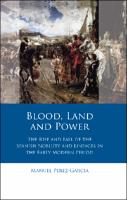
        Blood, Land and Power

        The Rise and Fall of the Spanish Nobility and Lineages in the Early Modern Period
        Thumbnail
        Download PDF Viewer
        Author(s)
        Perez-Garcia, Manuel
        Collection
        European Research Council (ERC); EU collection
        Language
        English
        Show full item record
        Abstract
        The analysis of land management, lineage and family through the case study of early modern Spanish nobility from sixteenth to early nineteenth century is a major issue in recent historiography. It aims to shed light on how upper social classes arranged strategies to maintain their political and economic status. Rivalry and disputes between old factions and families were attached to the control and exercise of power. Blood, land management and honour were the main elements in these disputes. Honour, service to the Crown, participation in the conquest and ‘pure’ blood (Catholic affiliation) were the main features of Spanish nobility. This book analyses the origins of the entailed-estate (mayorazgo) from medieval times to early modern period, as the main element that enables us to understand the socio-economic behaviour of these families over generations. This longue durée chronology within the Braudelian methodology of the research aims to show how strategies and family networks changed over time, demonstrating a micro-history study of daily life.
        URI
        https://library.oapen.org/handle/20.500.12657/47859
        Keywords
        Iberian and Latin American Studies;Spanish history;Spanish nobility;social classes;lineage
        ISBN
        9781786837110, 9781786837103
        Publisher
        University of Wales Press
        Publication date and place
        Cardiff, 2021
        Grantor
        • H2020 European Research Council - 679371 - GECEM Research grant informationFind all documents
        Classification
        Spain
        16th century, c 1500 to c 1599
        17th century, c 1600 to c 1699
        18th century, c 1700 to c 1799
        19th century, c 1800 to c 1899
        European history
        Social classes
        Pages
        352
        Rights
        https://creativecommons.org/licenses/by-nc-nd/4.0/
        • Imported or submitted locally

        Browse

        All of OAPENSubjectsPublishersLanguagesCollections

        My Account

        LoginRegister

        Export

        Repository metadata
        Logo Oapen
        • For Librarians
        • For Publishers
        • For Researchers
        • Funders
        • Resources
        • OAPEN

        Newsletter

        • Subscribe to our newsletter
        • view our news archive

        Follow us on

        License

        • If not noted otherwise all contents are available under Attribution 4.0 International (CC BY 4.0)

        Credits

        • logo EU
        • This project received funding from the European Union's Horizon 2020 research and innovation programme under grant agreement No 683680, 810640, 871069 and 964352.

        OAPEN is based in the Netherlands, with its registered office in the National Library in The Hague.

        Director: Niels Stern

        Address:
        OAPEN Foundation
        Prins Willem-Alexanderhof 5
        2595 BE The Hague
        Postal address:
        OAPEN Foundation
        P.O. Box 90407
        2509 LK The Hague

        Websites:
        OAPEN Home: www.oapen.org
        OAPEN Library: library.oapen.org
        DOAB: www.doabooks.org


        Export search results

        The export option will allow you to export the current search results of the entered query to a file. Differen formats are available for download. To export the items, click on the button corresponding with the preferred download format.

        A logged-in user can export up to 15000 items. If you're not logged in, you can export no more than 500 items.

        To select a subset of the search results, click "Selective Export" button and make a selection of the items you want to export. The amount of items that can be exported at once is similarly restricted as the full export.

        After making a selection, click one of the export format buttons. The amount of items that will be exported is indicated in the bubble next to export format.