
Logo Oapen
  • Join
    • Deposit
    • For Librarians
    • For Publishers
    • For Researchers
    • Funders
    • Resources
    • OAPEN
        View Item 
        •   OAPEN Home
        • View Item
        •   OAPEN Home
        • View Item
        JavaScript is disabled for your browser. Some features of this site may not work without it.

        Verwaltete Vielfalt

        Die königlichen Tafelgüter in Polen-Litauen, 1697–1763
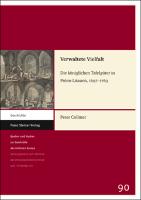
        Thumbnail
        Download PDF Viewer
        Author(s)
        Collmer, Peter
        Collection
        Knowledge Unlatched (KU); Swiss National Science Foundation (SNF); KU Open Services
        Language
        German
        Show full item record
        Abstract
        Vielfalt prägte das frühneuzeitliche Europa. Am Beispiel der königlichen Domänen in Polen-Litauen lässt sich dies besonders gut zeigen. Die landwirtschaftlichen Güter der königlichen "Tafel" (mensa regia) lagen wie ein Archipel über das Territorium der Adelsrepublik verstreut. Sie bildeten eine herrschaftliche Kontaktzone, die sich durch sprachliche, konfessionelle und strukturelle Diversität auszeichnete und in der auch unterschiedliche Herrschaftskulturen aufeinandertrafen. Dies gilt besonders für die Jahrzehnte nach 1697, als mit August II. (dem ""Starken"") und August III. zwei sächsische Kurfürsten auf dem polnischen Thron saßen. Die königliche Eigenwirtschaft entwickelte sich nun zunehmend zu einer Keimzelle der Bürokratisierung und des frühmodernen Staates auf dem Territorium Polen-Litauens. Peter Collmer zeigt am Beispiel der polnisch-litauischen Adelsrepublik, was Vielfalt für die Konzeption und Realisierung von Herrschaft vor dem Zeitalter des Nationalismus bedeutete. Er versteht Herrschaft als kommunikativen Prozess und kontrastiert die Geschichte der Institutionen immer wieder durch Einblicke in die Lebenswelten der Akteure.
        URI
        https://library.oapen.org/handle/20.500.12657/53434
        Keywords
        History
        DOI
        https://doi.org/10.25162/9783515131292
        ISBN
        9783515131292
        Publisher
        Franz Steiner Verlag
        Publisher website
        http://www.steiner-verlag.de/
        Publication date and place
        2022
        Grantor
        • Knowledge Unlatched
        • Schweizerischer Nationalfonds zur Förderung der Wissenschaftlichen Forschung
        Imprint
        Franz Steiner Verlag
        Classification
        History
        Rights
        https://creativecommons.org/licenses/by-nc-nd/4.0/legalcode
        • Harvested from KU

        Browse

        All of OAPENSubjectsPublishersLanguagesCollections

        My Account

        LoginRegister

        Export

        Repository metadata
        Logo Oapen
        • For Librarians
        • For Publishers
        • For Researchers
        • Funders
        • Resources
        • OAPEN

        Newsletter

        • Subscribe to our newsletter
        • view our news archive

        Follow us on

        License

        • If not noted otherwise all contents are available under Attribution 4.0 International (CC BY 4.0)

        Credits

        • logo EU
        • This project received funding from the European Union's Horizon 2020 research and innovation programme under grant agreement No 683680, 810640, 871069 and 964352.

        OAPEN is based in the Netherlands, with its registered office in the National Library in The Hague.

        Director: Niels Stern

        Address:
        OAPEN Foundation
        Prins Willem-Alexanderhof 5
        2595 BE The Hague
        Postal address:
        OAPEN Foundation
        P.O. Box 90407
        2509 LK The Hague

        Websites:
        OAPEN Home: www.oapen.org
        OAPEN Library: library.oapen.org
        DOAB: www.doabooks.org


        Export search results

        The export option will allow you to export the current search results of the entered query to a file. Differen formats are available for download. To export the items, click on the button corresponding with the preferred download format.

        A logged-in user can export up to 15000 items. If you're not logged in, you can export no more than 500 items.

        To select a subset of the search results, click "Selective Export" button and make a selection of the items you want to export. The amount of items that can be exported at once is similarly restricted as the full export.

        After making a selection, click one of the export format buttons. The amount of items that will be exported is indicated in the bubble next to export format.