
Logo Oapen
  • Join
    • Deposit
    • For Librarians
    • For Publishers
    • For Researchers
    • Funders
    • Resources
    • OAPEN
        View Item 
        •   OAPEN Home
        • View Item
        •   OAPEN Home
        • View Item
        JavaScript is disabled for your browser. Some features of this site may not work without it.

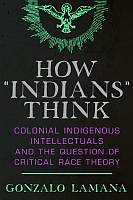
        How “Indians” Think

        Colonial Indigenous Intellectuals and the Question of Critical Race Theory
        Thumbnail
        Download
        Author(s)
        Lamana, Gonzalo
        Collection
        Knowledge Unlatched (KU); KU Select 2022: HSS Backlist Books
        Language
        English
        Show full item record
        Abstract
        The conquest and colonization of the Americas marked the beginning of a social, economic, and cultural change of global scale. Most of what we know about how colonial actors understood and theorized this complex historical transformation comes from Spanish sources. This makes the few texts penned by Indigenous intellectuals in colonial times so important: they allow us to see how some of those who inhabited the colonial world in a disadvantaged position thought and felt about it. This book shines light on Indigenous perspectives through a novel interpretation of the works of the two most important Amerindian intellectuals in the Andes, Felipe Guaman Poma de Ayala and Garcilaso de la Vega, el Inca. Building on but also departing from the predominant scholarly position that views Indigenous-Spanish relations as the clash of two distinct cultures, Gonzalo Lamana argues that Guaman Poma and Garcilaso were the first Indigenous activist intellectuals and that they developed post-racial imaginaries four hundred years ago. Their texts not only highlighted Native peoples’ achievements, denounced injustice, and demanded colonial reform, but they also exposed the emerging Spanish thinking and feeling on race that was at the core of colonial forms of discrimination. These authors aimed to alter the way colonial actors saw each other and, as a result, to change the world in which they lived.
        URI
        https://library.oapen.org/handle/20.500.12657/53527
        Keywords
        Social Science; Indigenous Studies; History; Latin America; South America; Social Science; Anthropology; Cultural & Social
        ISBN
        9780816548446
        Publisher
        University of Arizona Press
        Publisher website
        https://uapress.arizona.edu/
        Publication date and place
        2019
        Imprint
        University of Arizona Press
        Classification
        Indigenous peoples
        Relating to Indigenous peoples
        History of the Americas
        Social and cultural anthropology
        Rights
        https://creativecommons.org/licenses/by-nc-nd/4.0/legalcode
        • Harvested from KU

        Browse

        All of OAPENSubjectsPublishersLanguagesCollections

        My Account

        LoginRegister

        Export

        Repository metadata
        Logo Oapen
        • For Librarians
        • For Publishers
        • For Researchers
        • Funders
        • Resources
        • OAPEN

        Newsletter

        • Subscribe to our newsletter
        • view our news archive

        Follow us on

        License

        • If not noted otherwise all contents are available under Attribution 4.0 International (CC BY 4.0)

        Credits

        • logo EU
        • This project received funding from the European Union's Horizon 2020 research and innovation programme under grant agreement No 683680, 810640, 871069 and 964352.

        OAPEN is based in the Netherlands, with its registered office in the National Library in The Hague.

        Director: Niels Stern

        Address:
        OAPEN Foundation
        Prins Willem-Alexanderhof 5
        2595 BE The Hague
        Postal address:
        OAPEN Foundation
        P.O. Box 90407
        2509 LK The Hague

        Websites:
        OAPEN Home: www.oapen.org
        OAPEN Library: library.oapen.org
        DOAB: www.doabooks.org


        Export search results

        The export option will allow you to export the current search results of the entered query to a file. Differen formats are available for download. To export the items, click on the button corresponding with the preferred download format.

        A logged-in user can export up to 15000 items. If you're not logged in, you can export no more than 500 items.

        To select a subset of the search results, click "Selective Export" button and make a selection of the items you want to export. The amount of items that can be exported at once is similarly restricted as the full export.

        After making a selection, click one of the export format buttons. The amount of items that will be exported is indicated in the bubble next to export format.