
Logo Oapen
  • Join
    • Deposit
    • For Librarians
    • For Publishers
    • For Researchers
    • Funders
    • Resources
    • OAPEN
        View Item 
        •   OAPEN Home
        • View Item
        •   OAPEN Home
        • View Item
        JavaScript is disabled for your browser. Some features of this site may not work without it.

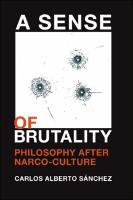
        A Sense of Brutality

        Philosophy after Narco-Culture
        Thumbnail
        Download PDF Viewer
        Download
        Author(s)
        Sánchez, Carlos Alberto
        Language
        English
        Show full item record
        Abstract
        Contemporary popular culture is riddled with references to Mexican drug cartels, narcos, and drug trafficking. In the United States, documentary filmmakers, journalists, academics, and politicians have taken note of the increasing threats to our security coming from a subculture that appears to feed on murder and brutality while being fed by a romanticism about power and capital. Carlos Alberto Sánchez uses Mexican narco-culture as a point of departure for thinking about the nature and limits of violence, culture, and personhood. A Sense of Brutality argues that violent cultural modalities, of which narco-culture is but one, call into question our understanding of “violence” as a concept. The reality of narco-violence suggests that “violence” itself is insufficient to capture it, that we need to redeploy and reconceptualize “brutality” as a concept that better captures this reality. Brutality is more than violence, other to cruelty, and distinct from horror and terror—all concepts that are normally used interchangeably with brutality, but which, as the analysis suggests, ought not to be. In narco-culture, the normalization of brutality into everyday life is a condition upon which the absolute erasure or derealization of people is made possible.
        URI
        https://library.oapen.org/handle/20.500.12657/57780
        Keywords
        Drug traffic -- Mexico.; Drug traffic -- Mexican-American Border Region.; Drug control -- United States.; Organized crime -- Mexico.; Violence -- Philosophy.; Cruelty -- Philosophy.
        DOI
        10.3998/mpub.11923978
        ISBN
        9781943208159, 9781943208159, 9781943208142
        Publisher
        Amherst College Press
        Publisher website
        https://acpress.amherst.edu/
        Publication date and place
        2020
        Imprint
        Amherst College Press
        Classification
        Philosophy
        Pages
        170
        Rights
        https://creativecommons.org/licenses/by-nc/4.0/
        • Imported or submitted locally

        Browse

        All of OAPENSubjectsPublishersLanguagesCollections

        My Account

        LoginRegister

        Export

        Repository metadata
        Logo Oapen
        • For Librarians
        • For Publishers
        • For Researchers
        • Funders
        • Resources
        • OAPEN

        Newsletter

        • Subscribe to our newsletter
        • view our news archive

        Follow us on

        License

        • If not noted otherwise all contents are available under Attribution 4.0 International (CC BY 4.0)

        Credits

        • logo EU
        • This project received funding from the European Union's Horizon 2020 research and innovation programme under grant agreement No 683680, 810640, 871069 and 964352.

        OAPEN is based in the Netherlands, with its registered office in the National Library in The Hague.

        Director: Niels Stern

        Address:
        OAPEN Foundation
        Prins Willem-Alexanderhof 5
        2595 BE The Hague
        Postal address:
        OAPEN Foundation
        P.O. Box 90407
        2509 LK The Hague

        Websites:
        OAPEN Home: www.oapen.org
        OAPEN Library: library.oapen.org
        DOAB: www.doabooks.org


        Export search results

        The export option will allow you to export the current search results of the entered query to a file. Differen formats are available for download. To export the items, click on the button corresponding with the preferred download format.

        A logged-in user can export up to 15000 items. If you're not logged in, you can export no more than 500 items.

        To select a subset of the search results, click "Selective Export" button and make a selection of the items you want to export. The amount of items that can be exported at once is similarly restricted as the full export.

        After making a selection, click one of the export format buttons. The amount of items that will be exported is indicated in the bubble next to export format.