
Logo Oapen
  • Join
    • Deposit
    • For Librarians
    • For Publishers
    • For Researchers
    • Funders
    • Resources
    • OAPEN
        View Item 
        •   OAPEN Home
        • View Item
        •   OAPEN Home
        • View Item
        JavaScript is disabled for your browser. Some features of this site may not work without it.

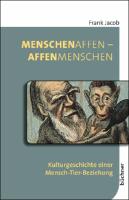
        MenschenAffen – AffenMenschen

        Kulturgeschichte einer Mensch-Tier-Beziehung
        Thumbnail
        Download PDF Viewer
        Web Shop
        Author(s)
        Jacob, Frank
        Language
        German
        Show full item record
        Abstract
        Monkeys are probably the animals with which we most readily identify when it comes to recognizing the human in the animal. Nevertheless, they symbolize, as it were, a fear of human degeneration. The particular human-animal relationship is the subject of this cultural history. Frank Jacob explains what role apes played for the self-perception of humans and how they were and are understood as humanoid animals, for example as objects in research and popular media. In doing so, he sheds light on a history of relationships that continues to this day, whereby the intensity of this relationship between humans and primates has been redefined again and again over the centuries.
        URI
        https://library.oapen.org/handle/20.500.12657/59227
        Keywords
        Human-Animal Studies; Cultural History; Animal History; Media Studies; Film Studies; King Kong; Planet of the Apes; Charles Darwin; Samuel Serge Voronoff; Mary Sanders Pollock; Thomas Henry Huxley; Godzilla; Colonialism
        DOI
        10.14631/978-3-96317-724-8
        ISBN
        9783963177248, 9783963172014
        Publisher
        Büchner-Verlag
        Publication date and place
        2022
        Series
        Beiträge zur Tiergeschichte, 4
        Classification
        Media studies
        Films, cinema
        Popular culture
        Nature in art
        Pages
        144
        Rights
        https://creativecommons.org/licenses/by-nc/4.0/
        • Imported or submitted locally

        Browse

        All of OAPENSubjectsPublishersLanguagesCollections

        My Account

        LoginRegister

        Export

        Repository metadata
        Logo Oapen
        • For Librarians
        • For Publishers
        • For Researchers
        • Funders
        • Resources
        • OAPEN

        Newsletter

        • Subscribe to our newsletter
        • view our news archive

        Follow us on

        License

        • If not noted otherwise all contents are available under Attribution 4.0 International (CC BY 4.0)

        Credits

        • logo EU
        • This project received funding from the European Union's Horizon 2020 research and innovation programme under grant agreement No 683680, 810640, 871069 and 964352.

        OAPEN is based in the Netherlands, with its registered office in the National Library in The Hague.

        Director: Niels Stern

        Address:
        OAPEN Foundation
        Prins Willem-Alexanderhof 5
        2595 BE The Hague
        Postal address:
        OAPEN Foundation
        P.O. Box 90407
        2509 LK The Hague

        Websites:
        OAPEN Home: www.oapen.org
        OAPEN Library: library.oapen.org
        DOAB: www.doabooks.org


        Export search results

        The export option will allow you to export the current search results of the entered query to a file. Differen formats are available for download. To export the items, click on the button corresponding with the preferred download format.

        A logged-in user can export up to 15000 items. If you're not logged in, you can export no more than 500 items.

        To select a subset of the search results, click "Selective Export" button and make a selection of the items you want to export. The amount of items that can be exported at once is similarly restricted as the full export.

        After making a selection, click one of the export format buttons. The amount of items that will be exported is indicated in the bubble next to export format.