
Hidden Depths
The Origins of Human Connection
 Download
 Web Shop
Abstract
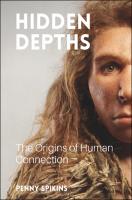
In Hidden Depths, Professor Penny Spikins explores how our emotional connections have shaped human ancestry. Focusing on three key transitions in human origins, Professor Spikins explains how the emotional capacities of our early ancestors evolved in response to ecological changes, much like similar changes in other social mammals. For each transition, dedicated chapters examine evolutionary pressures, responses in changes in human emotional capacities and the archaeological evidence for human social behaviours. Starting from our earliest origins, in Part One, Professor Spikins explores how after two million years ago, movement of human ancestors into a new ecological niche drove new types of collaboration, including care for vulnerable members of the group. Emotional adaptations lead to cognitive changes, as new connections based on compassion, generosity, trust and inclusion also changed our relationship to material things. Part Two explores a later key transition in human emotional capacities occurring after 300,000 years ago. At this time changes in social tolerance allowed ancestors of our own species to further reach out beyond their local group and care about distant allies, making human communities resilient to environmental changes. An increasingly close relationship to animals, and even to cherished possessions, appeared at this time, and can be explained through new human vulnerabilities and ways of seeking comfort and belonging. Lastly, Part Three focuses on the contrasts in emotional dispositions arising between ourselves and our close cousins, the Neanderthals. Neanderthals are revealed as equally caring yet emotionally different humans, who might, if things had been different, have been in our place today. This new narrative breaks away from traditional views of human evolution as exceptional or as a linear progression towards a more perfect form. Instead, our evolutionary history is situated within similar processes occurring in other mammals, and explained as one in which emotions, rather than ‘intellect’, were key to our evolutionary journey. Moreover, changes in emotional capacities and dispositions are seen as part of differing pathways each bringing strengths, weaknesses and compromises. These hidden depths provide an explanation for many of the emotional sensitivities and vulnerabilities which continue to influence our world today.
Keywords
Human demography; Group size; Lithic transfers; Raw material movements; Bonobos; Dog burial; Comfort; Symbolic objects; Symbolism; Mobiliary art; Attachment fluidity; Hypersociability; Human-animal relationships; Dog domestication; Attachment object; Approachability; Approach behaviour; Avoidance behaviour; Androgens; Physiological responses; Cognitive Archaeology; Autism Spectrum Condition; Handaxe; Biface; Neurodiversity; Palaeolithic stone tools; Evolution of neurodiversity; Rock art; Ice age art; Material Culture; Cultural transmission; Emotional commitment; Biopsychosocial approach; Social tolerance; Attachment; Genus Homo; Acheulian; Cultural evolution; Skeletal abnormality; Injury; Illness; Interdependence; Emotional sensitivity; Moral emotions; Evolution of Altruism; Hominins; Upper Palaeolithic; Lower Palaeolithic; Ecological niche; Selective pressure; Behavioural ecology; Wolves; Affective empathy; Cognitive empathy; Theory of mind; Human Cognition; Vulnerability; Evolutionary Psychology; Developmental psychology; Helping behaviours; Social cognition; Social mammals; Human Emotion; Human social collaboration; Generosity; Emotional brain; Social emotions; Comparative behaviour; Evolution; Social carnivores; Primate behavioural ecology; Primate social systems; Human Evolution; Human ancestors; Collaboration; Evolutionary Biology; Emotional vulnerability; Social connection; Decolonisation; Social networks; Middle Palaeolithic; Community resilience; Convergent evolution; Chimpanzee; Origin of modern humans; Social safeness; Wolf domestication; Cherished possessions; Compensatory attachment; Loneliness; Palaeolithic art; Stress reactivity; Bonding hormones; Humans; Hunter-gatherers; Intergroup collaboration; Tolerance; Emotional connection; Autism; Trust; Early Prehistory; Palaeopathology; Origins of healthcare; Human self-domestication; Palaeolithic Archaeology; Social brain; Care-giving; Empathy; Neanderthals; Compassion; Social Connection; Evolution of Emotions; Human Origins; Adaptation; PrehistoryDOI
10.22599/HiddenDepthsISBN
9781912482320, 9781912482320, 9781912482337, 9781912482344, 9781912482351Publisher
White Rose University PressPublisher website
https://universitypress.whiterose.ac.uk/Publication date and place
York, 2022Imprint
White Rose University PressClassification
Anthropology
Archaeology
Biology, life sciences
Ecological science, the Biosphere
Evolution
Revolutionary groups and movements
Psychology