
Logo Oapen
  • Join
    • Deposit
    • For Librarians
    • For Publishers
    • For Researchers
    • Funders
    • Resources
    • OAPEN
        View Item 
        •   OAPEN Home
        • View Item
        •   OAPEN Home
        • View Item
        JavaScript is disabled for your browser. Some features of this site may not work without it.

        Chapter Concluding Remarks

        Proposal review
        Thumbnail
        Download PDF Viewer
        Author(s)
        Destrooper, Tine
        Engstrom, Par
        Language
        English
        Show full item record
        Abstract
        This chapter concludes the volume, drawing together its different theoretical and empirical chapters. It argues that there is merit in looking beyond paradigmatic transitional contexts, since such a focus allows transitional justice to become relevant for a variety of justice actors, enables a decolonization of the field, and offers a new perspective on what can be expected of transitional justice. To make this argument the chapter discusses five themes that surface in the empirical chapters describing when transitional justice travels to aparadigmatic cases: 1. Pluralism and the unsettled character of transitional justice. 2. The standardisation of localized justice initiatives. 3. Ongoing transitions. 4. Political will and legitimacy. 5. Bridging the divide between scholars and practitioners. These five themes help to understand the contemporary field of transitional justice as it has expanded from transitional to non-transitional, aparadigmatic contexts.
        Book
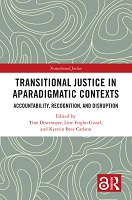
        Transitional Justice in Aparadigmatic Contexts
        URI
        https://library.oapen.org/handle/20.500.12657/61704
        Keywords
        Transitional Justice, Aparadigmatic Contexts, Educational Programmes
        DOI
        10.4324/9781003289104-13
        ISBN
        9781003289104, 9781032266176, 9781032266152
        Publisher
        Taylor & Francis
        Publisher website
        https://taylorandfrancis.com/
        Publication date and place
        2023
        Grantor
        • Universiteit Gent
        Imprint
        Routledge
        Classification
        International law
        Peace studies and conflict resolution
        War crimes
        Violence and abuse in society
        Criminal law: procedure and offences
        Crime and criminology
        Pages
        15
        Public remark
        Imprint: Glasshouse
        Rights
        https://creativecommons.org/licenses/by-nc-nd/4.0/
        • Imported or submitted locally

        Browse

        All of OAPENSubjectsPublishersLanguagesCollections

        My Account

        LoginRegister

        Export

        Repository metadata
        Logo Oapen
        • For Librarians
        • For Publishers
        • For Researchers
        • Funders
        • Resources
        • OAPEN

        Newsletter

        • Subscribe to our newsletter
        • view our news archive

        Follow us on

        License

        • If not noted otherwise all contents are available under Attribution 4.0 International (CC BY 4.0)

        Credits

        • logo EU
        • This project received funding from the European Union's Horizon 2020 research and innovation programme under grant agreement No 683680, 810640, 871069 and 964352.

        OAPEN is based in the Netherlands, with its registered office in the National Library in The Hague.

        Director: Niels Stern

        Address:
        OAPEN Foundation
        Prins Willem-Alexanderhof 5
        2595 BE The Hague
        Postal address:
        OAPEN Foundation
        P.O. Box 90407
        2509 LK The Hague

        Websites:
        OAPEN Home: www.oapen.org
        OAPEN Library: library.oapen.org
        DOAB: www.doabooks.org


        Export search results

        The export option will allow you to export the current search results of the entered query to a file. Differen formats are available for download. To export the items, click on the button corresponding with the preferred download format.

        A logged-in user can export up to 15000 items. If you're not logged in, you can export no more than 500 items.

        To select a subset of the search results, click "Selective Export" button and make a selection of the items you want to export. The amount of items that can be exported at once is similarly restricted as the full export.

        After making a selection, click one of the export format buttons. The amount of items that will be exported is indicated in the bubble next to export format.