
Logo Oapen
  • Join
    • Deposit
    • For Librarians
    • For Publishers
    • For Researchers
    • Funders
    • Resources
    • OAPEN
        View Item 
        •   OAPEN Home
        • View Item
        •   OAPEN Home
        • View Item
        JavaScript is disabled for your browser. Some features of this site may not work without it.

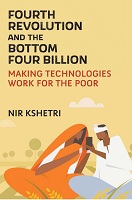
        Fourth Revolution and the Bottom Four Billion

        External Review of Whole Manuscript

        Making Technologies Work for the Poor
        Thumbnail
        Download PDF Viewer
        Author(s)
        Kshetri, Nir
        Collection
        Knowledge Unlatched (KU)
        Language
        English
        Show full item record
        Abstract
        Products and services based on advanced technologies such as artificial intelligence and blockchain are normally considered to be for rich consumers in advanced countries. Fourth Revolution and the Bottom Four Billion demonstrates how marginalized and vulnerable groups with limited resources can also benefit from these technologies. Nir Kshetri suggests that the falling costs and the increased ease of developing and deploying applications based on these technologies are making them more accessible. He illustrates how key emerging technologies are transforming major industries and application areas such as healthcare and pandemic preparedness, agriculture, finance, banking, and insurance. The book also looks at how these transformations are affecting the lives of low-income people in low- and middle-income countries and highlights the areas needing regulatory attention to adequately protect marginalized and vulnerable groups from the abuse and misuse of these technologies. Kshetri discusses how various barriers such as the lack of data, low resource languages, underdeveloped technology infrastructures, lack of computing power and shortage of skill and talent have hindered the adoption of these technologies among marginalized and vulnerable groups. Fourth Revolution and the Bottom Four Billion suggests that it is the responsibility of diverse stakeholders—governments, NGOs, international development organizations, academic institutions, the private sector, and others—to ensure that marginal groups also benefit from these transformative innovations.
        URI
        https://library.oapen.org/handle/20.500.12657/62887
        Keywords
        Artificial Intelligence, Augmented Reality, Blockchain, Bottom Four Billion, Cryptocurrency, Digital colonialism, Data labeling, Financial Technology, Fourth Industrial Revolution, General Purpose Technology, Genome Editing, Industry 4.0, Information and Communications Technology, Internet of Things, Low-income economies, Microfinance Institution, Natural Language Processing, Peer-to-peer lender, Poverty, Poverty Trap, Remote Sensing, Smallholder farmers, Sub-Saharan Africa
        DOI
        10.3998/mpub.12205632
        ISBN
        9780472903214, 9780472075898, 9780472055890
        Publisher
        University of Michigan Press
        Publisher website
        https://www.press.umich.edu/
        Publication date and place
        2023
        Grantor
        • Knowledge Unlatched
        • UK Research and Innovation
        Classification
        Society and culture: general
        Development studies
        Central / national / federal government policies
        Politics and government
        Impact of science and technology on society
        Pages
        374
        Rights
        https://creativecommons.org/licenses/by-nc-nd/4.0/
        • Imported or submitted locally

        Browse

        All of OAPENSubjectsPublishersLanguagesCollections

        My Account

        LoginRegister

        Export

        Repository metadata
        Logo Oapen
        • For Librarians
        • For Publishers
        • For Researchers
        • Funders
        • Resources
        • OAPEN

        Newsletter

        • Subscribe to our newsletter
        • view our news archive

        Follow us on

        License

        • If not noted otherwise all contents are available under Attribution 4.0 International (CC BY 4.0)

        Credits

        • logo EU
        • This project received funding from the European Union's Horizon 2020 research and innovation programme under grant agreement No 683680, 810640, 871069 and 964352.

        OAPEN is based in the Netherlands, with its registered office in the National Library in The Hague.

        Director: Niels Stern

        Address:
        OAPEN Foundation
        Prins Willem-Alexanderhof 5
        2595 BE The Hague
        Postal address:
        OAPEN Foundation
        P.O. Box 90407
        2509 LK The Hague

        Websites:
        OAPEN Home: www.oapen.org
        OAPEN Library: library.oapen.org
        DOAB: www.doabooks.org


        Export search results

        The export option will allow you to export the current search results of the entered query to a file. Differen formats are available for download. To export the items, click on the button corresponding with the preferred download format.

        A logged-in user can export up to 15000 items. If you're not logged in, you can export no more than 500 items.

        To select a subset of the search results, click "Selective Export" button and make a selection of the items you want to export. The amount of items that can be exported at once is similarly restricted as the full export.

        After making a selection, click one of the export format buttons. The amount of items that will be exported is indicated in the bubble next to export format.