
Logo Oapen
  • Join
    • Deposit
    • For Librarians
    • For Publishers
    • For Researchers
    • Funders
    • Resources
    • OAPEN
        View Item 
        •   OAPEN Home
        • View Item
        •   OAPEN Home
        • View Item
        JavaScript is disabled for your browser. Some features of this site may not work without it.

        Lahore Cinema

        Between Realism and Fable
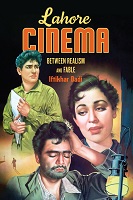
        Thumbnail
        Download PDF Viewer
        Download
        Web Shop
        Author(s)
        Dadi, Iftikhar
        Collection
        Toward an Open Monograph Ecosystem (TOME)
        Language
        English
        Show full item record
        Abstract
        Commercial cinema has been among the most powerful vectors of social and aesthetic modernization in South Asia. So argues Iftikhar Dadi in his provocative examination of cinema produced between 1956 and 1969—the long sixties—in Lahore, Pakistan, following the 1947 Partition of South Asia. These films drew freely from Bengali performance traditions, Hindu mythology, Parsi theater, Sufi conceptions of the self, Urdu lyric poetry, and Hollywood musicals, bringing these traditions into dialogue with melodrama and neorealism. Examining this layered context offers insights into a period of rapid modernization and into cultural affiliation in the South Asian present, when frameworks of multiplicity and plurality are in jeopardy. Lahore Cinema probes the role of language, rhetoric, lyric, and form in the making of cinematic meaning as well as the relevance of the Urdu cultural universe to midcentury Bombay filmmaking. Challenging the assumption of popular cinema as apolitical, Dadi explores how films allowed their audiences to navigate an accelerating modernity and tense politics by anchoring social change across the terrain of deeper cultural imaginaries. By constituting publics beyond social divides of regional, ethnic, and sectarian affiliations, commercial cinema played an influential progressive role during the mid- and later twentieth century in South Asia. Lahore Cinema is freely available in an open access edition thanks to TOME (Toward an Open Monograph Ecosystem) and the generous support of Cornell University. DOI: 10.6069/9780295750804
        URI
        https://library.oapen.org/handle/20.500.12657/75535
        Keywords
        Film history, theory and criticism;Asian history
        DOI
        10.6069/9780295750804
        ISBN
        9780295750804, 9780295750804, 9780295750798, 9780295750811
        Publisher
        University of Washington Press
        Publication date and place
        Seattle, 2022
        Grantor
        • Cornell University - TOME
        Series
        Global South Asia,
        Pages
        266
        Rights
        https://creativecommons.org/licenses/by-nc-nd/4.0/
        • Imported or submitted locally

        Browse

        All of OAPENSubjectsPublishersLanguagesCollections

        My Account

        LoginRegister

        Export

        Repository metadata
        Logo Oapen
        • For Librarians
        • For Publishers
        • For Researchers
        • Funders
        • Resources
        • OAPEN

        Newsletter

        • Subscribe to our newsletter
        • view our news archive

        Follow us on

        License

        • If not noted otherwise all contents are available under Attribution 4.0 International (CC BY 4.0)

        Credits

        • logo EU
        • This project received funding from the European Union's Horizon 2020 research and innovation programme under grant agreement No 683680, 810640, 871069 and 964352.

        OAPEN is based in the Netherlands, with its registered office in the National Library in The Hague.

        Director: Niels Stern

        Address:
        OAPEN Foundation
        Prins Willem-Alexanderhof 5
        2595 BE The Hague
        Postal address:
        OAPEN Foundation
        P.O. Box 90407
        2509 LK The Hague

        Websites:
        OAPEN Home: www.oapen.org
        OAPEN Library: library.oapen.org
        DOAB: www.doabooks.org


        Export search results

        The export option will allow you to export the current search results of the entered query to a file. Differen formats are available for download. To export the items, click on the button corresponding with the preferred download format.

        A logged-in user can export up to 15000 items. If you're not logged in, you can export no more than 500 items.

        To select a subset of the search results, click "Selective Export" button and make a selection of the items you want to export. The amount of items that can be exported at once is similarly restricted as the full export.

        After making a selection, click one of the export format buttons. The amount of items that will be exported is indicated in the bubble next to export format.