
Logo Oapen
  • Join
    • Deposit
    • For Librarians
    • For Publishers
    • For Researchers
    • Funders
    • Resources
    • OAPEN
        View Item 
        •   OAPEN Home
        • View Item
        •   OAPEN Home
        • View Item
        JavaScript is disabled for your browser. Some features of this site may not work without it.

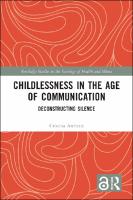
        Childlessness in the Age of Communication

        Proposal review

        Deconstructing Silence
        Thumbnail
        Download PDF Viewer
        Author(s)
        Archetti, Cristina
        Language
        English
        Show full item record
        Abstract
        Cristina Archetti started researching childlessness after being diagnosed with ""unexplained infertility"". She soon discovered that, although involuntary childlessness affects an increasing number of women and men across the world, this topic is shrouded taboo and shame. This book is both a first-person reflection about the existential questions posed by involuntary childlessness and a readable account of the way the silence surrounding this topic is socially and politically constructed. Revealing the invisible mechanisms that, from the microscopic details of everyday life to policy, make up the structure of silence around childlessness, Archetti demonstrates what it means not to have children in a society that is organized around families. Through a prose that mixes analysis, excerpts of interviews, media fragments, and evocative writing, she develops a new language of feeling-in-the-body fit for the twenty-first century and exposes the devastating effects infertility has on relationships, identity, health and well-being, in societies that fetishize parenthood. Childlessness in the Age of Communication draws upon a range of disciplines and fields including sociology, health, gender and sexuality studies, communication, politics and anthropology. It is a book for all those interested in childlessness and innovative qualitative research methodologies.
        URI
        https://library.oapen.org/handle/20.500.12657/75917
        Keywords
        evocative writing;involuntary childlessness;political communication
        DOI
        10.4324/9780367810399
        ISBN
        9781000033342, 9780367810399, 9780367409944, 9781032478067
        Publisher
        Taylor & Francis
        Publisher website
        https://taylorandfrancis.com/
        Publication date and place
        2020
        Grantor
        • University of Oslo
        Imprint
        Routledge
        Pages
        284
        Rights
        https://creativecommons.org/licenses/by-nc-nd/4.0/
        • Imported or submitted locally

        Browse

        All of OAPENSubjectsPublishersLanguagesCollections

        My Account

        LoginRegister

        Export

        Repository metadata
        Logo Oapen
        • For Librarians
        • For Publishers
        • For Researchers
        • Funders
        • Resources
        • OAPEN

        Newsletter

        • Subscribe to our newsletter
        • view our news archive

        Follow us on

        License

        • If not noted otherwise all contents are available under Attribution 4.0 International (CC BY 4.0)

        Credits

        • logo EU
        • This project received funding from the European Union's Horizon 2020 research and innovation programme under grant agreement No 683680, 810640, 871069 and 964352.

        OAPEN is based in the Netherlands, with its registered office in the National Library in The Hague.

        Director: Niels Stern

        Address:
        OAPEN Foundation
        Prins Willem-Alexanderhof 5
        2595 BE The Hague
        Postal address:
        OAPEN Foundation
        P.O. Box 90407
        2509 LK The Hague

        Websites:
        OAPEN Home: www.oapen.org
        OAPEN Library: library.oapen.org
        DOAB: www.doabooks.org


        Export search results

        The export option will allow you to export the current search results of the entered query to a file. Differen formats are available for download. To export the items, click on the button corresponding with the preferred download format.

        A logged-in user can export up to 15000 items. If you're not logged in, you can export no more than 500 items.

        To select a subset of the search results, click "Selective Export" button and make a selection of the items you want to export. The amount of items that can be exported at once is similarly restricted as the full export.

        After making a selection, click one of the export format buttons. The amount of items that will be exported is indicated in the bubble next to export format.