
Logo Oapen
  • Join
    • Deposit
    • For Librarians
    • For Publishers
    • For Researchers
    • Funders
    • Resources
    • OAPEN
        View Item 
        •   OAPEN Home
        • View Item
        •   OAPEN Home
        • View Item
        JavaScript is disabled for your browser. Some features of this site may not work without it.

        Gender, Emotions and Power, 1750–2020
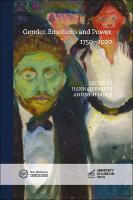
        Thumbnail
        Download PDF Viewer
        Contributor(s)
        Parker, Hannah (editor)
        Doble, Josh (editor)
        Collection
        Knowledge Unlatched (KU); KU Select 2023: HSS Frontlist Books
        Language
        English
        Show full item record
        Abstract
        This collection of essays constitutes a timely intervention into contemporary debates on emotions, gender, race and power. Interrogating how emotional expectations are established as gendered, racialised and class-based notions, the volume explores the ways these expectations have been generated, stratified and maintained by institutions, societies, media and those with access to power.The collection draws upon a diverse set of case studies to present a chronologically and geographically broad intervention. The authors identify and explore connections between the depiction of twentieth-century transnational feminists, settler colonies in southern Africa, post-unification Italy, Maoist China, the twentieth-century Soviet Union and the medicalized spaces of the British Raj. Contributions also move across time from notions of eighteenth-century British masculinity, through Victorian Britain and whiteness in settler colonialism, to the Liverpool docks of the 1990s and contemporary Russia. Collectively, the volume’s authors seek to understand how the normalisation of emotions as a range of gendered qualities forms the basis upon which notions of self, and connectedly, social identities are performed. As such, this is an important contribution to the history of emotions that addresses how gender and emotions are formed as co-constituents within dominant power structures, in different geographic and temporal spaces.
        URI
        https://library.oapen.org/handle/20.500.12657/86083
        Keywords
        History; Social History; Social Science; Gender Studies
        DOI
        10.14296/cwfb4352
        ISBN
        9781915249197, 9781915249197
        Publisher
        University of London Press
        Publisher website
        https://uolpress.co.uk/
        Publication date and place
        2024
        Grantor
        • Knowledge Unlatched
        Imprint
        University of London
        Rights
        https://creativecommons.org/licenses/by-nc-nd/4.0/
        • Harvested from KU

        Browse

        All of OAPENSubjectsPublishersLanguagesCollections

        My Account

        LoginRegister

        Export

        Repository metadata
        Logo Oapen
        • For Librarians
        • For Publishers
        • For Researchers
        • Funders
        • Resources
        • OAPEN

        Newsletter

        • Subscribe to our newsletter
        • view our news archive

        Follow us on

        License

        • If not noted otherwise all contents are available under Attribution 4.0 International (CC BY 4.0)

        Credits

        • logo EU
        • This project received funding from the European Union's Horizon 2020 research and innovation programme under grant agreement No 683680, 810640, 871069 and 964352.

        OAPEN is based in the Netherlands, with its registered office in the National Library in The Hague.

        Director: Niels Stern

        Address:
        OAPEN Foundation
        Prins Willem-Alexanderhof 5
        2595 BE The Hague
        Postal address:
        OAPEN Foundation
        P.O. Box 90407
        2509 LK The Hague

        Websites:
        OAPEN Home: www.oapen.org
        OAPEN Library: library.oapen.org
        DOAB: www.doabooks.org


        Export search results

        The export option will allow you to export the current search results of the entered query to a file. Differen formats are available for download. To export the items, click on the button corresponding with the preferred download format.

        A logged-in user can export up to 15000 items. If you're not logged in, you can export no more than 500 items.

        To select a subset of the search results, click "Selective Export" button and make a selection of the items you want to export. The amount of items that can be exported at once is similarly restricted as the full export.

        After making a selection, click one of the export format buttons. The amount of items that will be exported is indicated in the bubble next to export format.