
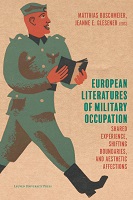
European Literatures of Military Occupation
Shared Experience, Shifting Boundaries, and Aesthetic Affections
 Download
 Download
Contributor(s)
Buschmeier, Matthias (editor)
Glesener, Jeanne E. (editor)
Collection
Knowledge Unlatched (KU); KU Open ServicesLanguage
EnglishAbstract
Occupation literature: a new perspective on European identities
What does it mean to live under occupation? How does it shape the culture and identities of European nations? How does it affect the way we write and read literature? These are fundamental questions that set the stage for an in-depth exploration. Focusing on the literary works of writers from various European countries that were occupied by Nazi Germany, the Soviet Union or the Allies during and after World War II, the contributions in this edited volume seek to unravel the complex interplay between historical circumstances and literary expression. Centered on the concept of occupation literature as a genre in its own right, differentiating it from 'war literature', the book navigates this subtle distinction, drawing connections with the Holocaust novel and extending the timeframe beyond Nazi occupation.
European Literatures of Military Occupation argues that the multifaceted experiences of occupation have played a pivotal role in shaping European identities. Moreover, the volume links European identities to the experience of occupation by unveiling the complex and diverse ways in which writers respond to historical and political circumstances. Introducing the concept of 'affective realism' and exploring its intersection with the occupation novel, the book provides nuanced insights into the intricate relationship between history, identity, and literature. It combines theoretical perspectives relevant to researchers in the humanities with detailed case studies, generating a truly interdisciplinary perspective, enriched by a strong transnational dimension, creating a cohesive narrative that intervenes innovatively in the fields of literary, cultural, and historical criticism.
Ebook available in Open Access.
This publication is GPRC-labeled (Guaranteed Peer-Reviewed Content). Contributors: Klaus-Michael Bogdal (Bielefeld University), Jan Andres (Bielefeld University), Benedikts Kalnačs (University of Latvia), Stefan Laffin (Leibnitz University of Hannover), Daniela Lieb (Centre national de littérature, Luxembourg), Atinati Mamatsashvil (Ilia State University), Christopher Meid (University of Freiburg), Aleksandar Momčilović (independent scholar), Jeroen Olyslaegers (independent literary author), Joanna Rzepa (University of Essex), Sandra Schell (Heidelberg University), Meinolf Schumacher (Bielefeld University), Stefanie Siess (Heidelberg University)
Keywords
World War II;Post-war period;Military Occupation;Occupation literature;Cultural memory;European IdentitiesDOI
10.11116/9789461665546ISBN
9789461665546, 9789461665911, 9789461665911, 9789462704077Publisher
Leuven University PressPublisher website
https://lup.be/Publication date and place
Leuven, 2024Classification
Literary studies: c 1900 to c 2000