
Logo Oapen
  • Join
    • Deposit
    • For Librarians
    • For Publishers
    • For Researchers
    • Funders
    • Resources
    • OAPEN
        View Item 
        •   OAPEN Home
        • View Item
        •   OAPEN Home
        • View Item
        JavaScript is disabled for your browser. Some features of this site may not work without it.

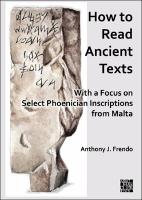
        How to Read Ancient Texts

        With a Focus on Select Phoenician Inscriptions from Malta
        Thumbnail
        Download PDF Viewer
        Author(s)
        Frendo, Anthony J.
        Collection
        Knowledge Unlatched (KU); KU Open Services
        Language
        English
        Show full item record
        Abstract
        How to Read Ancient Texts foregrounds the principles of interpretation that scholars employ when reading ancient inscriptions. In order to better come to grips with Canaanite, such as Phoenician, inscriptions, we need to first understand how people wrote and read texts in the ancient Mediterranean world, including that of the Greeks and Romans. The use of continual script and lack of punctuation did not pose insurmountable problems to the ancients, since spoken language is not built on a division between words but on two-second spurts of sounds with pauses in between. This shows the crucial role that lectors and consequently orality played in antiquity. It is clear that philological analysis is crucial when it comes to reading Phoenician inscriptions, such as those examined here. However, in texts with no word division, no punctuation, and no vowels (such as Phoenician inscriptions), context plays a crucial role. That context turns out to be threefold: the textual context that an inscription itself provides, its archaeological context, and also (as in the case of the papyrus inscription examined as a case study here) the wider Mediterranean context, such as that of ancient Egypt. In the case of the Phoenician inscription CIS I, 123 it is the archaeological context that allows us to pin down one highly probable interpretation out of multiple philological solutions that are theoretically possible. The Phoenician inscriptions examined here show us more clearly and with greater probability that the Phoenicians in Malta did practice child sacrifice and that they also had very strong links with the Phoenicians in Egypt.
        URI
        https://library.oapen.org/handle/20.500.12657/93362
        Keywords
        CFL
        DOI
        https://doi.org/10.32028/9781803278278
        Publisher
        Archaeopress Publishing
        Publisher website
        https://www.archaeopress.com/
        Publication date and place
        2024
        Grantor
        • Knowledge Unlatched
        Imprint
        Archaeopress Publishing Ltd
        Rights
        https://creativecommons.org/licenses/by-nc-nd/4.0/legalcode
        • Harvested from KU

        Browse

        All of OAPENSubjectsPublishersLanguagesCollections

        My Account

        LoginRegister

        Export

        Repository metadata
        Logo Oapen
        • For Librarians
        • For Publishers
        • For Researchers
        • Funders
        • Resources
        • OAPEN

        Newsletter

        • Subscribe to our newsletter
        • view our news archive

        Follow us on

        License

        • If not noted otherwise all contents are available under Attribution 4.0 International (CC BY 4.0)

        Credits

        • logo EU
        • This project received funding from the European Union's Horizon 2020 research and innovation programme under grant agreement No 683680, 810640, 871069 and 964352.

        OAPEN is based in the Netherlands, with its registered office in the National Library in The Hague.

        Director: Niels Stern

        Address:
        OAPEN Foundation
        Prins Willem-Alexanderhof 5
        2595 BE The Hague
        Postal address:
        OAPEN Foundation
        P.O. Box 90407
        2509 LK The Hague

        Websites:
        OAPEN Home: www.oapen.org
        OAPEN Library: library.oapen.org
        DOAB: www.doabooks.org


        Export search results

        The export option will allow you to export the current search results of the entered query to a file. Differen formats are available for download. To export the items, click on the button corresponding with the preferred download format.

        A logged-in user can export up to 15000 items. If you're not logged in, you can export no more than 500 items.

        To select a subset of the search results, click "Selective Export" button and make a selection of the items you want to export. The amount of items that can be exported at once is similarly restricted as the full export.

        After making a selection, click one of the export format buttons. The amount of items that will be exported is indicated in the bubble next to export format.