
The Detroit Genre
Race, Dispossession, and Resilience in American Literature and Film, 1967-2023
 Download
Abstract
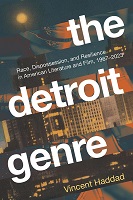
Detroit has an essential relationship to genre in American literature and popular culture. The contemporary formations of the suburban sitcom, the post-apocalyptic genre, the sci-fi dystopia, crime fiction, the superhero genre, and contemporary horror would not exist in the way they do today without the aesthetic material and racial history of Detroit. When DC Comics wanted to compete with Marvel and market “socially relevant” comics, especially ones dealing with issues of race, they swapped Gotham and Metropolis for Detroit. What about vampires concerned with de-industrialization, heritage conservation, and impending water wars? Must be Detroit. A story about a half-man, half-robot wrestling with what it means to be human by fighting crime? Improbably, Detroit has two. Author Vincent Haddad’s The Detroit Genre provides the first comprehensive literary and cultural investigation of the representations of Detroit in popular and literary culture.
The book first establishes the concept of the “Detroit genre” that emerged in late 1960s and traces the tropes of this white-centric narrative genre in popular culture, touching on key texts including Blue Collar, Robocop, The Crow, It Follows, and Barbarian. The second part shows how Black writers, including Alice Randall, adrienne maree brown, Stephen Mack Jones, and Angela Flournoy, reclaimed and revised the Detroit genre by un-fixing Detroit narratives of dispossession, criminality, and industrial and social failure through formal experimentations on genre itself.
Where Detroit has typically been painted in the news as one of three things—the center of the automotive industry; crime-ridden and in ruins; or as a “blank canvas” with limitless potential of entrepreneurship—Vincent Haddad shows that the Detroit genre in literature and film can be far more powerful than news media in narrating Black dispossession as a pragmatic, even liberal consensus. The texts studied here condition forgetfulness about Detroit’s history or expose it to a full reckoning, direct attention toward or away from the city’s agents of injustice, fetishize resilience or model resistance, and foreclose or imagine a future of Black liberation. Appealing to scholars of popular literature, media, race, and American studies, The Detroit Genre is an accessible and engaging study of the city’s influence on a wide array of genres in pop culture.
Keywords
Detroit, Genre, Literature, Lit Crit, Black, African American, Popular Culture, Dystopia, Apocalypse, Myths, Resilience, Property Informality, Homeownership, Property Abandonment, Dispossession, Crime Fiction, Superheroes, Heist Movies, Robocop, The Crow, Danny Brown, Alice Randall, Stephen Mack Jones, adrienne maree brownDOI
10.3998/mpub.14432416ISBN
9781643150697, 9781643150680Publisher
Lever PressPublisher website
https://www.leverpress.org/Publication date and place
2024Classification
Literature: history and criticism