
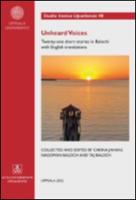
Unheard Voices Twenty-one short stories in Balochi with English translations. Collected and edited by Carina Jahani, Nagoman Baloch and Taj Baloch (Góshán Nakaptagén Tawár : Balóchiay bist o yakk ázmánk gón Engrézi rajánkán. Nazz árók: Káriná Jaháni, Nágomán Balóch o Táj Balóch)
Twenty-one short stories in Balochi with English translations. Collected and edited by Carina Jahani, Nagoman Baloch and Taj Baloch (Góshán Nakaptagén Tawár : Balóchiay bist o yakk ázmánk gón Engrézi rajánkán. Nazz árók: Káriná Jaháni, Nágomán Balóch o Táj Balóch)
 Download
 Web Shop
Contributor(s)
Jahani, Carina (editor)
Baloch, Nagoman (editor)
Baloch, Taj (editor)
Language
EnglishAbstract
This book presents twenty one Balochi short stories in Balochi-Latin and Balochi-Arabic script, as well as English translations and introductions of the authors in English. The stories have been edited to correspond to the grammatical and orthographic standards adopted by the Balochi Language Project and are arranged according to three themes: Human Relations, Man and his Environment, and Exile. The writing of short stories in Balochi began in the early 1950s and was mainly limited to Eastern (Pakistani) Balochistan. During the 1950s and 1960s a number of new writers of fiction emerged. The themes of stories by these early authors were often of a local character. Most of the stories are plot-centred and chronologically structured. Often an omniscient narrator tells the story. The writers frequently want to convey a message and depict injustices in society, and in doing so they indirectly call for social and political reforms. From the 1970s onward, a new generation of authors appeared on the scene. The writers belonging to the second generation are, as a rule, better educated than those of the first generation. They developed the short story genre by trying out new techniques and bringing in more varied and sometimes less locally anchored themes. Since the 1990s, a large number of new authors have emerged. New trends in Balochi short story writing include their increased readability, simplification of the language, separation of the characters in the stories from the author’s own ideology and a weaker urge to convey a message to the reader, as well as the treatment of taboo subjects that have not previously been addressed in Balochi literature. The growing number of women writers has also added a female voice, where women’s issues are no longer discussed only in a male-oriented discourse. The overwhelming dominance of writers from Pakistan is worth noting. Of the twenty-one authors represented in this anthology, only one comes from the western side of Balochistan, i.e. Iran. It is also noteworthy that several of the younger writers have had to leave their country and now live in exile.
Keywords
Balochi; Balochi literature; Baloch writers; short story; fiction; human relations; man and his environment; exile literatureDOI
10.33063/p1fjy658ISBN
9789151314044, 9789151314044Publisher
Uppsala University PublicationsPublication date and place
Uppsala, 2022Series
Studia Iranica Upsaliensia, 40Classification
Fiction and Related items
Anthologies: general
Indo-Iranian languages
Translation and interpretation