
Logo Oapen
  • Join
    • Deposit
    • For Librarians
    • For Publishers
    • For Researchers
    • Funders
    • Resources
    • OAPEN
        View Item 
        •   OAPEN Home
        • View Item
        •   OAPEN Home
        • View Item
        JavaScript is disabled for your browser. Some features of this site may not work without it.

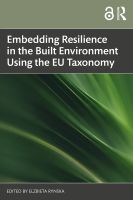
        Embedding Resilience in the Built Environment Using the EU Taxonomy

        Proposal review
        Thumbnail
        Contributor(s)
        Rynska, Elzbieta (editor)
        Language
        English
        Show full item record
        Abstract
        Taxonomy is the common name for an EU regulation that supports companies in sustainable environmental and climate action (Regulation [EU] No. 2020/852). It is a classification tool designed for investors, companies, and financial institutions to define the environmental impact of business activities and the requirements that organisations must meet to be considered as sustainable. The aim of this book is to examine the EU taxonomy from the built environment perspective and the ways in which it can be used to build resilience in real estate. It presents the issues, hot points, and possible choices from the designers, construction consultants, and investing bodies' points of view, those who must set forth initial conditions, which should later become the keystones for greener developments. It brings together the expertise of a unique team of both researchers and professionals and presents a methodology, case studies, and solutions which together comprise a novel understanding of the taxonomy’s influence on the pre-construction phase. The book: • describes the role of the built environment within sustainable development and how real estate can be used to build resilience with the use of taxonomy. • describes the characteristics of resilient environmentally friendly cities in the future. • proposes a roadmap to demonstrate urban policies that promote decarbonisation; and •enables investors to compare their products, operations, and strategies in terms of sustainability. Overall, this book is essential reading for decision-makers in the public and private sectors, urban developers, space and spatial designers, architects, planners, community stakeholders, and real estate investors. Chapter 1 of this book is freely available as a downloadable Open Access PDF at http://www.taylorfrancis.com under a Creative Commons Attribution-Non Commercial-No Derivatives (CC-BY-NC-ND) 4.0 license.
        URI
        https://library.oapen.org/handle/20.500.12657/98539
        Keywords
        European Green Deal,climate crisis,land use planning,real estate,spatial planning,investment,development,natural hazards,risk,urban spaces,urban policy,bio-architecture,efficient energy design,low-tech solutions,retrofit
        DOI
        10.1201/9781003535195
        ISBN
        9781032868097, 9781032878898, 9781003535195
        Publisher
        Taylor & Francis
        Publisher website
        https://taylorandfrancis.com/
        Publication date and place
        2025
        Imprint
        Routledge
        Classification
        Architecture
        Architectural structure and design
        City and town planning: architectural aspects
        Architecture: professional practice
        Environmentally-friendly (‘green’) architecture and design
        Building construction and materials
        Civil engineering, surveying and building
        Technology: general issues
        Environmentally-friendly (‘green’) architecture and design
        Chapters in this book
        • Chapter 1 Introduction to European Union Taxonomy
        Rights
        • Imported or submitted locally

        Browse

        All of OAPENSubjectsPublishersLanguagesCollections

        My Account

        LoginRegister

        Export

        Repository metadata
        Logo Oapen
        • For Librarians
        • For Publishers
        • For Researchers
        • Funders
        • Resources
        • OAPEN

        Newsletter

        • Subscribe to our newsletter
        • view our news archive

        Follow us on

        License

        • If not noted otherwise all contents are available under Attribution 4.0 International (CC BY 4.0)

        Credits

        • logo EU
        • This project received funding from the European Union's Horizon 2020 research and innovation programme under grant agreement No 683680, 810640, 871069 and 964352.

        OAPEN is based in the Netherlands, with its registered office in the National Library in The Hague.

        Director: Niels Stern

        Address:
        OAPEN Foundation
        Prins Willem-Alexanderhof 5
        2595 BE The Hague
        Postal address:
        OAPEN Foundation
        P.O. Box 90407
        2509 LK The Hague

        Websites:
        OAPEN Home: www.oapen.org
        OAPEN Library: library.oapen.org
        DOAB: www.doabooks.org


        Export search results

        The export option will allow you to export the current search results of the entered query to a file. Differen formats are available for download. To export the items, click on the button corresponding with the preferred download format.

        A logged-in user can export up to 15000 items. If you're not logged in, you can export no more than 500 items.

        To select a subset of the search results, click "Selective Export" button and make a selection of the items you want to export. The amount of items that can be exported at once is similarly restricted as the full export.

        After making a selection, click one of the export format buttons. The amount of items that will be exported is indicated in the bubble next to export format.