
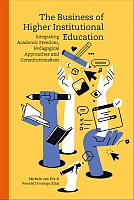
The Business of Higher Institutional Education
Integrating Academic Freedom, Pedagogical Approaches and Constitutionalism
 Download
Contributor(s)
Domingo, Wesahl (editor)
van Eck, Michele (editor)
Language
EnglishAbstract
Higher education is facing increasing challenges. Economic and financial pressures have heightened the strain on the sustainability of higher education institutions (HEIs). These pressures have prompted a shift toward adopting business models and commercial practices to maintain institutional operations. While these changes have enabled some innovations, they have also placed traditional academic dynamics under significant pressure. After all, the commercialisation of HEIs comes with its own challenges and has influenced (directly and indirectly) academic freedom, constitutional values, and established approaches to teaching, learning and research. This co-edited book explores the growing tension between academic freedom and the commercial priorities of HEIs, highlighting the challenge of balancing financial sustainability with higher education’s function of being centres of knowledge, innovation and social change. Through an analysis of selected legal, academic, and operational dimensions, this book examines how HEIs can navigate these demands while maintaining their core identity. Organised around three key themes, the first focuses on the business and commercial aspects of HEIs, analysing how these influence institutional operations. Topics under this theme include issues such as corruption, procurement practices, the use of demand guarantees in construction contracts, and the legal nature of the student-university relationship. The second theme examines how the business and commercial focus of HEIs can influence academic freedom. Topics under this theme includes an analysis of the rights of academics to freedom of expression and their ability to critique their employers, the implications of Ghana’s proposed Anti-LGBTQ+ Bill on academic freedom, and the effects of disciplinary procedures on academic freedom in Zimbabwean state universities. The third theme addresses the impact of commercialisation on teaching, learning, and pedagogical approaches within HEIs. Topics under this theme include the challenges faced by students with disabilities and the role of HEIs in breaking down barriers to inclusion, the influence of HEI structures on the decolonisation of international law, and the ways in which HEIs responded to the effects of Covid-19 on first-year law students at the University of Johannesburg. The academic contribution in this book highlights that HEIs serve a critical social function that goes beyond profit-making or financial viability. This social responsibility, rooted in knowledge creation and societal advancement, should remain the primary focus. Although commercialisation is an unavoidable reality, HEIs should ultimately prioritise their social mandate over profit-driven objectives, ensuring that their core mission is not overshadowed by commercial imperatives.
Keywords
Academic Freedom; Constitutionalism; Higher Education; PedagogyDOI
10.36615/9780906785249ISBN
9780906785249, 9781776489985, 9781776490004, 9781776489992Publisher
UJ PressPublisher website
https://ujonlinepress.uj.ac.za/index.php/ujpPublication date and place
Johannesburg, 2025Imprint
UJ PressClassification
Constitutional and administrative law: general