Logo Oapen
  • Join
    • Deposit
    • For Librarians
    • For Publishers
    • For Researchers
    • Funders
    • Resources
    • OAPEN
        View Item 
        •   OAPEN Home
        • View Item
        •   OAPEN Home
        • View Item
        JavaScript is disabled for your browser. Some features of this site may not work without it.

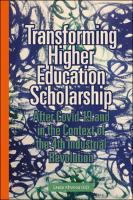
        Transforming Higher Education Scholarship after Covid-19 and in the Context of the 4th Industrial Revolution
        Thumbnail
        Download PDF Viewer
        Web Shop
        Author(s)
        Puleng, Segalo
        Radebe, Nompumelelo Zodwa
        Pillay, Roshini
        Kgope, Tebogo Victoria
        Baloyi, Magezi Elijah
        Ngakane, Bonny
        Madlela, Benkosi
        Tau, Siphokazi
        Contributor(s)
        KHUNOU, GRACE (editor)
        Language
        English
        Show full item record
        Abstract
        In this edited book we are compelled to think about the convergences between the technological advances made possible by lockdowns brought on by the Covid-19 Pandemic and increased 4IR use in the South African context. The insights presented in this edited volume make a case that transformation of higher education scholarship cannot happen without making space for historically excluded knowers, thinking differently about historically marginalized knowledges and by constantly grappling with new developments and how they facilitate or encumber the transformation project. Consequently, Transforming Higher Education Scholarship After Covid-19 and in the Context of the 4th Industrial Revolution does a good job of illustrating how shifts towards the advancement of 4IR in the South African Higher Education sector impacted the transformation trajectory. In their efforts to reimagine universities in Africa into African universities the authors in this edited volume grapple with how race and gender intersect in making the experiences of Black women in the South African academy untenable. The chapters also contend for the significance of pluriversal knowledges by making a case for the place of Indigenous Knowledges Systems in building African universities. As we grapple with the changes the 4IR has on the world and the teaching and learning landscape, some of the chapters in this volume make a compelling argument for thinking both from a critical perspective about what the challenges the developments coming out of these technologies mean for South Africa and the continent as well as what possibilities for positive impact these tools bring. Transforming Higher Education Scholarship After Covid-19 and in the Context of the 4th Industrial Revolution, is timely and makes an important contribution to higher education transformation discourses.
        URI
        https://library.oapen.org/handle/20.500.12657/99160
        Keywords
        4IR; Covid-19; Higher education; Scholarship
        DOI
        10.36615/9781776490073
        ISBN
        9781776490073, 9781776490073, 9781776490066, 9781776490097, 9781776490080
        Publisher
        UJ Press
        Publisher website
        https://ujonlinepress.uj.ac.za/index.php/ujp
        Publication date and place
        Johannesburg, 2024
        Imprint
        UJ Press
        Classification
        Higher education, tertiary education
        Pages
        238
        Rights
        https://creativecommons.org/licenses/by-nc/4.0
        • Imported or submitted locally

        Browse

        All of OAPENSubjectsPublishersLanguagesCollections

        My Account

        LoginRegister

        Export

        Repository metadata
        Logo Oapen
        • For Librarians
        • For Publishers
        • For Researchers
        • Funders
        • Resources
        • OAPEN

        Newsletter

        • Subscribe to our newsletter
        • view our news archive

        Follow us on

        License

        • If not noted otherwise all contents are available under Attribution 4.0 International (CC BY 4.0)

        Credits

        • logo EU
        • This project received funding from the European Union's Horizon 2020 research and innovation programme under grant agreement No 683680, 810640, 871069 and 964352.

        OAPEN is based in the Netherlands, with its registered office in the National Library in The Hague.

        Director: Niels Stern

        Address:
        OAPEN Foundation
        Prins Willem-Alexanderhof 5
        2595 BE The Hague
        Postal address:
        OAPEN Foundation
        P.O. Box 90407
        2509 LK The Hague

        Websites:
        OAPEN Home: www.oapen.org
        OAPEN Library: library.oapen.org
        DOAB: www.doabooks.org


        Export search results

        The export option will allow you to export the current search results of the entered query to a file. Differen formats are available for download. To export the items, click on the button corresponding with the preferred download format.

        A logged-in user can export up to 15000 items. If you're not logged in, you can export no more than 500 items.

        To select a subset of the search results, click "Selective Export" button and make a selection of the items you want to export. The amount of items that can be exported at once is similarly restricted as the full export.

        After making a selection, click one of the export format buttons. The amount of items that will be exported is indicated in the bubble next to export format.