Logo Oapen
  • Join
    • Deposit
    • For Librarians
    • For Publishers
    • For Researchers
    • Funders
    • Resources
    • OAPEN
        View Item 
        •   OAPEN Home
        • View Item
        •   OAPEN Home
        • View Item
        JavaScript is disabled for your browser. Some features of this site may not work without it.

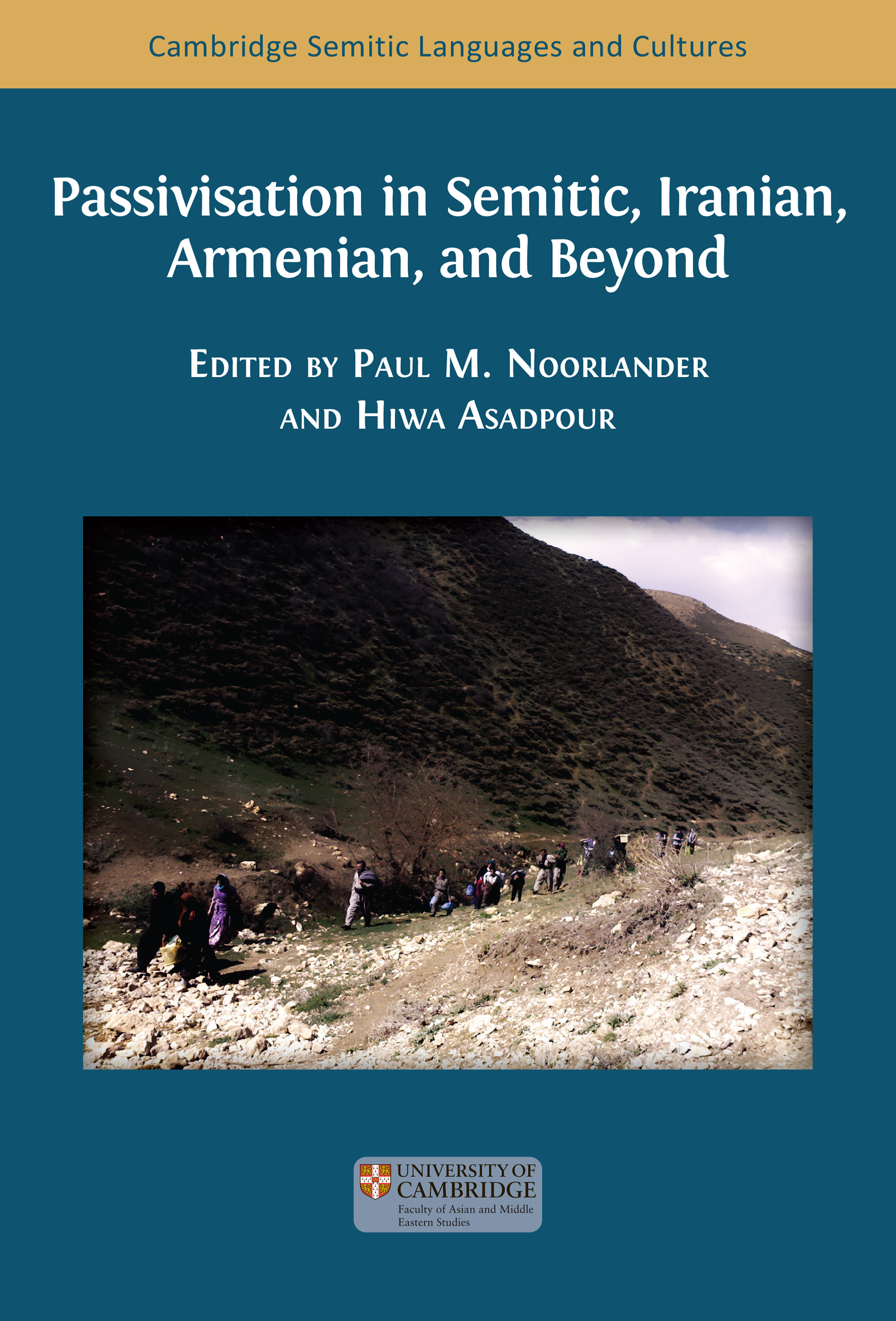
        Passivisation in Semitic, Iranian, Armenian, and Beyond

        https://www.openbookpublishers.com/books/10.11647/OBP.0516
        Thumbnail
        Download
        Download
        Download PDF Viewer
        Contributor(s)
        (editor) orcid
        (editor) orcid
        Language
        English
        Show full item record
        Abstract
        This volume brings together research on passive voice constructions in low-resource languages of Western Asia, a region marked by extraordinary linguistic diversity as well as a long history of cultural suppression and marginalisation. The contributions showcase the passive voice in Semitic, Iranian, Armenian, Greek, and Turkic languages, many of which are endangered, understudied, or confined to diaspora communities and disappearing language islands. Education and cultural expression in these languages remained heavily restricted across parts of Turkey, Syria, Iraq, and Iran, underscoring the urgent need for documentation and revitalisation. The chapters explore the rich typological variation of passive voice constructions, examining their typological traits, synchronic microvariation and diachronic developments. Drawing on Siewierska’s definition, the studies investigate processes of agent demotion and patient promotion, reductions in transitivity, and the fuzzy boundaries between passive and other detransitivisation strategies such as middles, anticausatives, statives and light verbs as well as impersonal subjects and agent omission. They also shed light on the impact of text genre, verbal aspect, and language contact on passivisation. By integrating theoretical, typological, historical, and areal perspectives, the volume discusses the internal stability of detransitivisation strategies, their evolution from earlier source constructions, and their position in voice systems more broadly. It raises fundamental questions about whether cross-linguistic tendencies in passives reflect universal patterns or area-specific historical contingencies. This collection thus provides an essential resource for scholars of all theoretical persuasions that are interested in voice and valency and/or in Western Asia’s linguistic diversity, while foregrounding the pressing need to support communities whose linguistic heritage is at risk.
        URI
        https://oapen-dev.siscern.org/handle/20.500.12657/108594
        Keywords
        Agent demotion; Detransitivisation; Diachronic development; Language contact; Passive constructions; Patient promotion
        DOI
        10.11647/OBP.0516
        ISBN
        9781805118268, 9781805118275, 9781805118282
        OCN
        1568989837
        Publisher
        Open Book Publishers
        Publisher website
        https://www.openbookpublishers.com/
        Publication date and place
        Cambridge, UK, 2026
        Imprint
        Open Book Publishers
        Series
        Semitic Languages and Cultures, 41
        Classification
        Middle East
        Linguistics
        Sociolinguistics
        Historical and comparative linguistics
        Grammar, syntax and morphology
        Pages
        385
        Rights
        https://creativecommons.org/licenses/by-nc/4.0/
        • Thoth SWORD collection

        Browse

        All of OAPENSubjectsPublishersLanguagesCollections

        My Account

        LoginRegister

        Export

        Repository metadata
        Logo Oapen
        • For Librarians
        • For Publishers
        • For Researchers
        • Funders
        • Resources
        • OAPEN

        Newsletter

        • Subscribe to our newsletter
        • view our news archive

        Follow us on

        License

        • If not noted otherwise all contents are available under Attribution 4.0 International (CC BY 4.0)

        Credits

        • logo EU
        • This project received funding from the European Union's Horizon 2020 research and innovation programme under grant agreement No 683680, 810640, 871069 and 964352.

        OAPEN is based in the Netherlands, with its registered office in the National Library in The Hague.

        Director: Niels Stern

        Address:
        OAPEN Foundation
        Prins Willem-Alexanderhof 5
        2595 BE The Hague
        Postal address:
        OAPEN Foundation
        P.O. Box 90407
        2509 LK The Hague

        Websites:
        OAPEN Home: www.oapen.org
        OAPEN Library: library.oapen.org
        DOAB: www.doabooks.org


        Export search results

        The export option will allow you to export the current search results of the entered query to a file. Differen formats are available for download. To export the items, click on the button corresponding with the preferred download format.

        A logged-in user can export up to 15000 items. If you're not logged in, you can export no more than 500 items.

        To select a subset of the search results, click "Selective Export" button and make a selection of the items you want to export. The amount of items that can be exported at once is similarly restricted as the full export.

        After making a selection, click one of the export format buttons. The amount of items that will be exported is indicated in the bubble next to export format.