
Lagos Never Spoils
Nollywood and Nigerian City Life
 Download
 Download
 Web Shop
Abstract
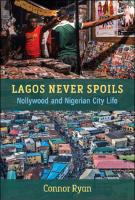
The slogan “Lagos shall not spoil,” found in print media, political campaigns, and common conversation, represents a shared expression of the optimism the city embodies. However, on city streets the phrase also appears scrawled in irreverent variations—“Lagos cannot spoil more than this!”—that meet the frustrations of city life with irony. In both cases, the slogan captures the resilience and persistence with which residents of Lagos live on, despite it all. This book examines the circumstances that make it possible for residents to persist in pursuing their various projects and for the city to remain a platform that supports these projects and creates space for even more to emerge. Author Connor Ryan argues that residents continually work to combine contingency and endurance in opportunistic ways that make the city work for them, and as such, Lagos never spoils: it endures. What makes Lagos remarkable is what residents have made of it, and Nollywood—the industry and the body of films—both embodies and represents this continual urban transformation. Lagos Never Spoils traces how Nollywood arose from the social milieu of Lagos and, in turn, generates a repertoire of stories, images, styles, and sentiments with which audiences come to grips with city life. The book traces the evolution of the screen media industry in Lagos and explores how this corresponds with historical phases in the city’s representation onscreen. It discusses important urban spaces of production and consumption, including historic movie halls, video marketplaces, film sets, and multiplex cinemas. Across six chapters, it attends to celluloid films about oil-boom wealth, television sitcoms about urban tricksters, video melodramas about urban crisis, glossy romantic comedies about young professionals, and dark thrillers on streaming platforms about the pleasure of moral transgression. In this fashion, the book offers new approaches to the interpretation of screen texts produced in and about Lagos, a place that is today the most influential image of West African city life.
Keywords
Nollywood; New Nollywood; Lagos; Nigeria; Genre; Infrastructure; Networks; Neoliberal; Governmentality; Open Endurance; Entanglement; Enclosure; Urban Ambivalence; Cinema; Video Film; Film; Film Studies; Media; Screen Media; Media Industry; Media Capital; Urban; Urbanism; Urban Studies; African Cities; City; City Life; Cinematic City; Global South; Postcolonial; Cultural Studies; Africa; African Studies; National Arts Theatre; Multiplex Cinema; Marketplace; Idumota; Alaba; Lagos Island; IROKOtv; FilmHouse; FilmOne; Netflix; Yoruba; Popular Theater; Traveling Theater; Nigerian Television Authority; Lagos (Nigeria) -- In motion pictures.; Motion pictures -- Social aspects -- Nigeria.; Motion pictures -- Political aspects -- Nigeria.; Motion pictures -- Nigeria -- History and criticism.; City and town life in motion pictures.; City and town life -- Nigeria -- Lagos.; Lagos (Nigeria) -- Social life and customs.; Aesthetics.; Criticism.DOI
10.3998/mpub.12472247ISBN
9780472906253, 9780472906253, 9780472906253, 9780472220984Publisher
Michigan State University PressPublication date and place
2026Imprint
University of Michigan PressSeries
African Perspectives,Classification
Society and culture: general
Film history, theory or criticism
Filmmaking and production: technical and background skills
Ethnic groups and multicultural studies