
Logo Oapen
  • Join
    • Deposit
    • For Librarians
    • For Publishers
    • For Researchers
    • Funders
    • Resources
    • OAPEN
        View Item 
        •   OAPEN Home
        • View Item
        •   OAPEN Home
        • View Item
        JavaScript is disabled for your browser. Some features of this site may not work without it.

        Continuous Pasts

        Frictions of Memory in Postcolonial Africa
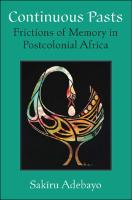
        Thumbnail
        Download
        Download PDF Viewer
        Web Shop
        Author(s)
        Adebayo, Sakiru
        Language
        English
        Show full item record
        Abstract
        In Continuous Pasts , author Sakiru Adebayo claims that the post-conflict fiction of memory in Africa depicts the intricate ways in which the past is etched on bodies and topographies, resonant in silences and memorials, and continuous even in experiences as well as structures of migration. Adebayo argues that the post-conflict fiction of memory in Africa invites critical deliberations on the continuity of the past within the realm of positionality and the domain of subjectivity—that is to say, the past is not merely present; instead, it survives, lives on, and is mediated through the subject positions of victims, perpetrators, as well as secondary and transgenerational witnesses. The book also argues that post-conflict fiction of memory in Africa shows the unfinished business of the past produces fragile regimes of peace and asynchronous temporalities that challenge progressive historicism. It contends that, in most cases in Africa, the post-conflict present is beset with a tight political economy wherein the scramble for survival trumps the ability to imagine a just future among survivors—and that it is precisely this despairing disposition toward the future that some writers of post-conflict fiction attempt to confront in their works. On the whole, Continuous Pasts shows how post-conflict fictions of memory in Africa recalibrate discourses of futurity, solidarity, responsibility, justice, survival, and reconciliation. It also contends that post-conflict fictions of memory in Africa provide the tools for imagining and theorizing a collective African memory. Each text analyzed in the book provides, in very interesting ways, an imaginative possibility and template for how post-independence African countries can ‘remember together’ using what the author describes as an African transnational memory framework.
        URI
        https://oapen-dev.siscern.org/handle/20.500.12657/108625
        Keywords
        Africa; African Studies; African Literature; African fiction; Postcolonial Africa; Postcolonial Studies; Postcolonial memory; Postcolonial memory studies; Memory studies; Fiction of memory; Nigeria; Biafra; Sierra Leonean civil war; Migration; Migration and memory; African immigrants; Rwandan genocide; Ethiopia; African immigrants in America; African literature -- 20th century -- History and criticism.; African literature -- 21st century -- History and criticism.; Postcolonialism -- Africa.; Collective memory -- Africa.; Memory -- Sociological aspects.; Memory in literature.; Social conflict in literature.
        DOI
        10.3998/mpub.12572368
        ISBN
        9780472906246, 9780472906246, 9780472906246, 9780472221196
        Publisher
        Michigan State University Press
        Publication date and place
        2026
        Imprint
        University of Michigan Press
        Series
        African Perspectives,
        Classification
        Literature: history and criticism
        African history
        Ethnic groups and multicultural studies
        Pages
        196
        Rights
        https://creativecommons.org/licenses/by-nc-nd/4.0/
        • Imported or submitted locally

        Browse

        All of OAPENSubjectsPublishersLanguagesCollections

        My Account

        LoginRegister

        Export

        Repository metadata
        Logo Oapen
        • For Librarians
        • For Publishers
        • For Researchers
        • Funders
        • Resources
        • OAPEN

        Newsletter

        • Subscribe to our newsletter
        • view our news archive

        Follow us on

        License

        • If not noted otherwise all contents are available under Attribution 4.0 International (CC BY 4.0)

        Credits

        • logo EU
        • This project received funding from the European Union's Horizon 2020 research and innovation programme under grant agreement No 683680, 810640, 871069 and 964352.

        OAPEN is based in the Netherlands, with its registered office in the National Library in The Hague.

        Director: Niels Stern

        Address:
        OAPEN Foundation
        Prins Willem-Alexanderhof 5
        2595 BE The Hague
        Postal address:
        OAPEN Foundation
        P.O. Box 90407
        2509 LK The Hague

        Websites:
        OAPEN Home: www.oapen.org
        OAPEN Library: library.oapen.org
        DOAB: www.doabooks.org


        Export search results

        The export option will allow you to export the current search results of the entered query to a file. Differen formats are available for download. To export the items, click on the button corresponding with the preferred download format.

        A logged-in user can export up to 15000 items. If you're not logged in, you can export no more than 500 items.

        To select a subset of the search results, click "Selective Export" button and make a selection of the items you want to export. The amount of items that can be exported at once is similarly restricted as the full export.

        After making a selection, click one of the export format buttons. The amount of items that will be exported is indicated in the bubble next to export format.